

On 18 November 2026, the Russian Association of Water Supply and Water Disposal (RAWW) published a Ministry of Industry and Trade consultation on critical industrial products for water utilities. The draft covers 2027, with 2028 and 2029 as planning years. The ministry’s letter requests equipment consumption and production data by 14 December 2026. Utilities preparing specifications can use the draft to identify equipment categories to review. Purchase eligibility and acceptance still depend on the documents and duty for each tender.
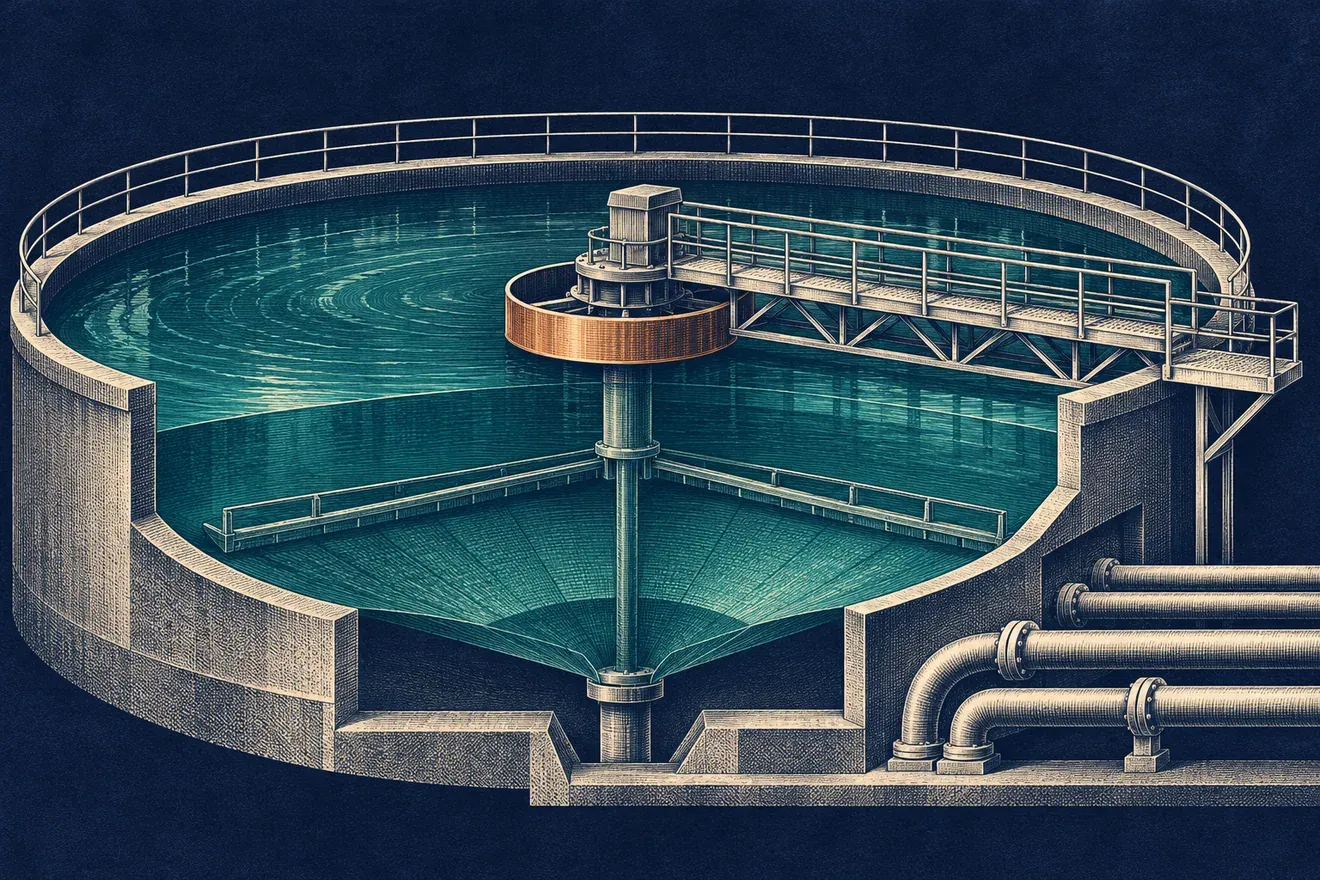
Cover: AI-generated concept illustration of a municipal clarifier.
What the draft covers
The letter cites Ministry Order No. 2192 of 21 May 2024 as the basis for the current revision. RAWW says the pump manufacturers’ association proposed dropping circulating and screw pumps from the draft because Russian-made options were already available, and that recycle pumps took their place. The draft also includes membrane elements. The pump change concerns the list’s scope. It leaves open which pump design suits a particular recirculation duty.
The accompanying form names eight positions. Its classification column uses the Russian qualifier из (“from” or “within”) before the codes. Read each code together with its named position.
| Draft position | Listed part of OKPD 2 group |
|---|---|
| Air-blowing units (blowers) | 28.13.2 |
| Recycle pumps | 28.13.14 |
| Reagent dosing stations | 28.13.12 |
| Submersible mixers | 28.29.12 |
| Screw dewaterers | 28.29.12 |
| Centrifuges | 28.29.41 |
| Modular and containerised domestic wastewater treatment units | 28.29.12 |
| Reverse-osmosis, nanofiltration and ultrafiltration membrane elements | 28.29.82.120 |
What the ministry is asking for
The form separates consumption from production and gives separate columns for 2027 and the 2028 and 2029 planning years. It asks for physical quantities where possible and monetary values in thousands of roubles. The published attachment is a blank form. The figures it requests therefore cannot be read as an estimate of the equipment market or evidence that a supplier has spare capacity. The letter highlights absent Russian production in the context of import dependence and situations where consumption exceeds production when considering proposals to add items.
For a useful response, a utility can tie estimates to a named asset or project and separate approved replacements from provisional plans. In internal working notes, keep forecast treatment capacity separate from equipment counts. Transfer the equipment figures to the ministry form. For example, a single planned upgrade can change the flow required from several recycle pumps while leaving the number of pump positions unchanged. For a membrane package, count complete modules or individual elements on a consistent basis and keep replacements separate from new installations.
What to verify before comparing bids
Keep two records for each line item. In the first, record the procurement notice, classification, and any documents the buyer expressly requires. In the second, record what the equipment has to do and how that duty will be demonstrated. For a recycle pump, compare the duty point at stated flow and total head together with the liquid’s solids load and the required operating range. For dewatering, agree on a representative sludge feed and compare cake solids and solids capture from the same test. The equipment family is a useful way to group responses, but it cannot substitute for those acceptance conditions.
The ministry’s feedback deadline is a date for reporting data and proposals. For a bid, confirm the final issued text and the tender’s own terms when those are available, including any applicable documentary requirements. This keeps category-level market monitoring separate from qualification of a specific package.
For a worked example, see the acceptance checks for sludge decanters.