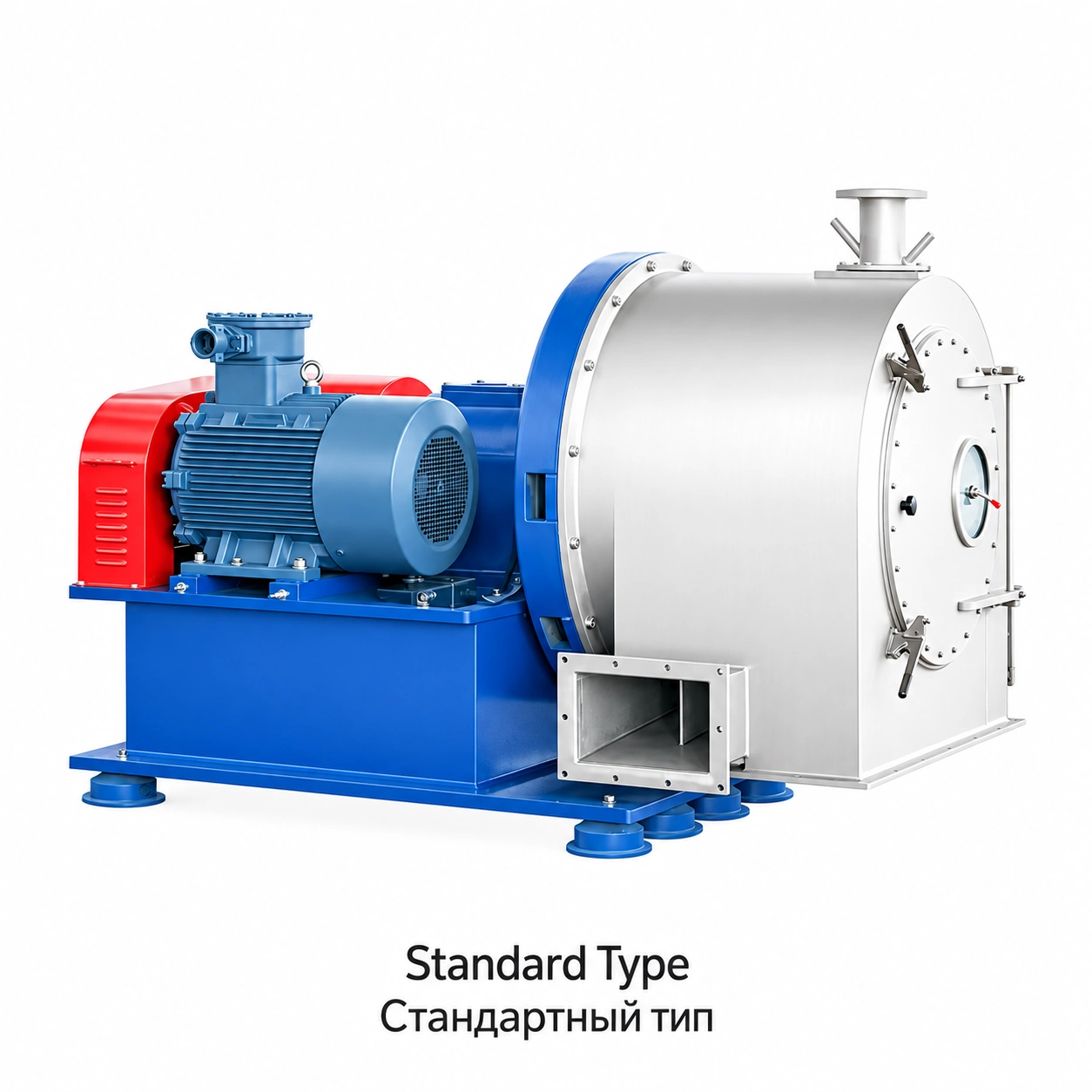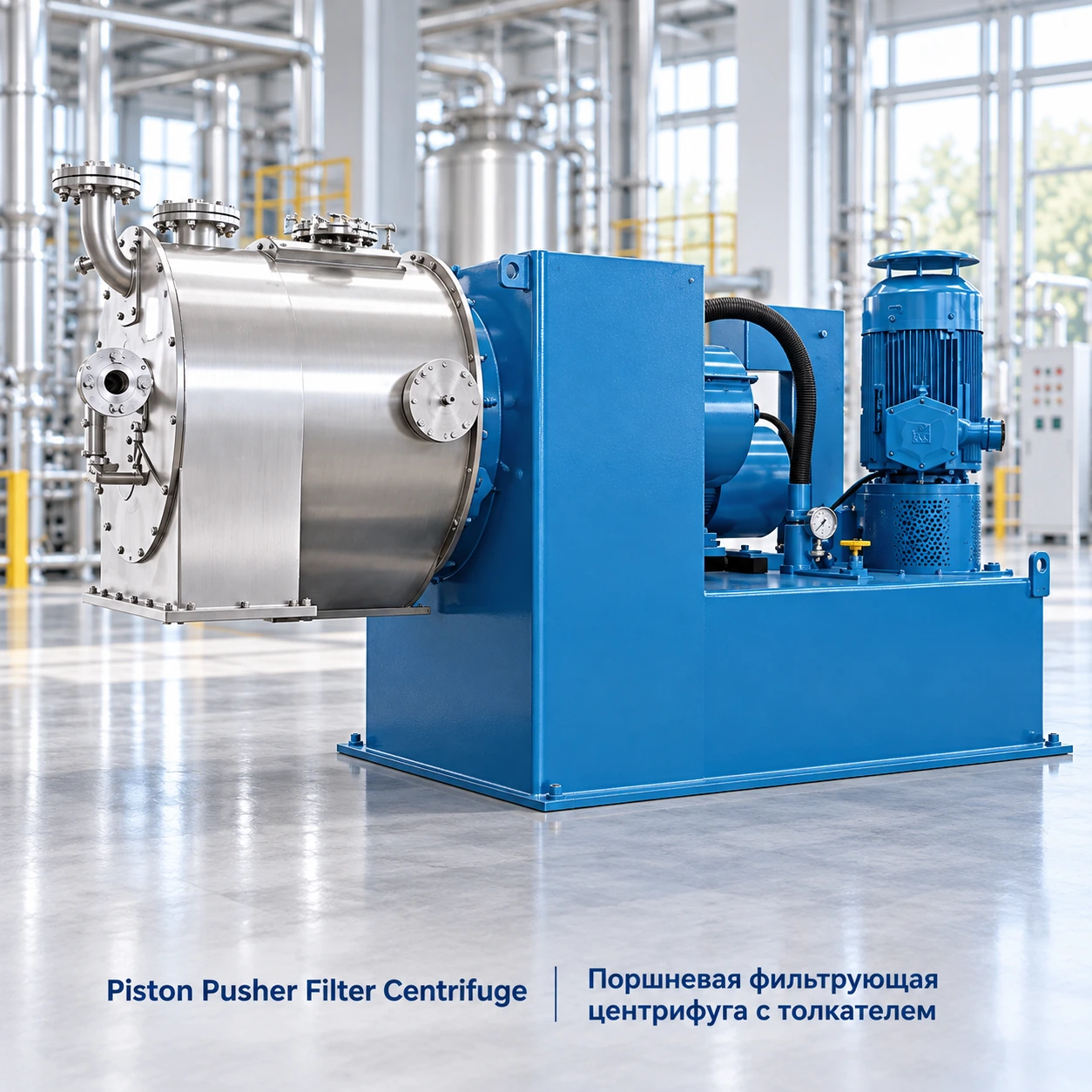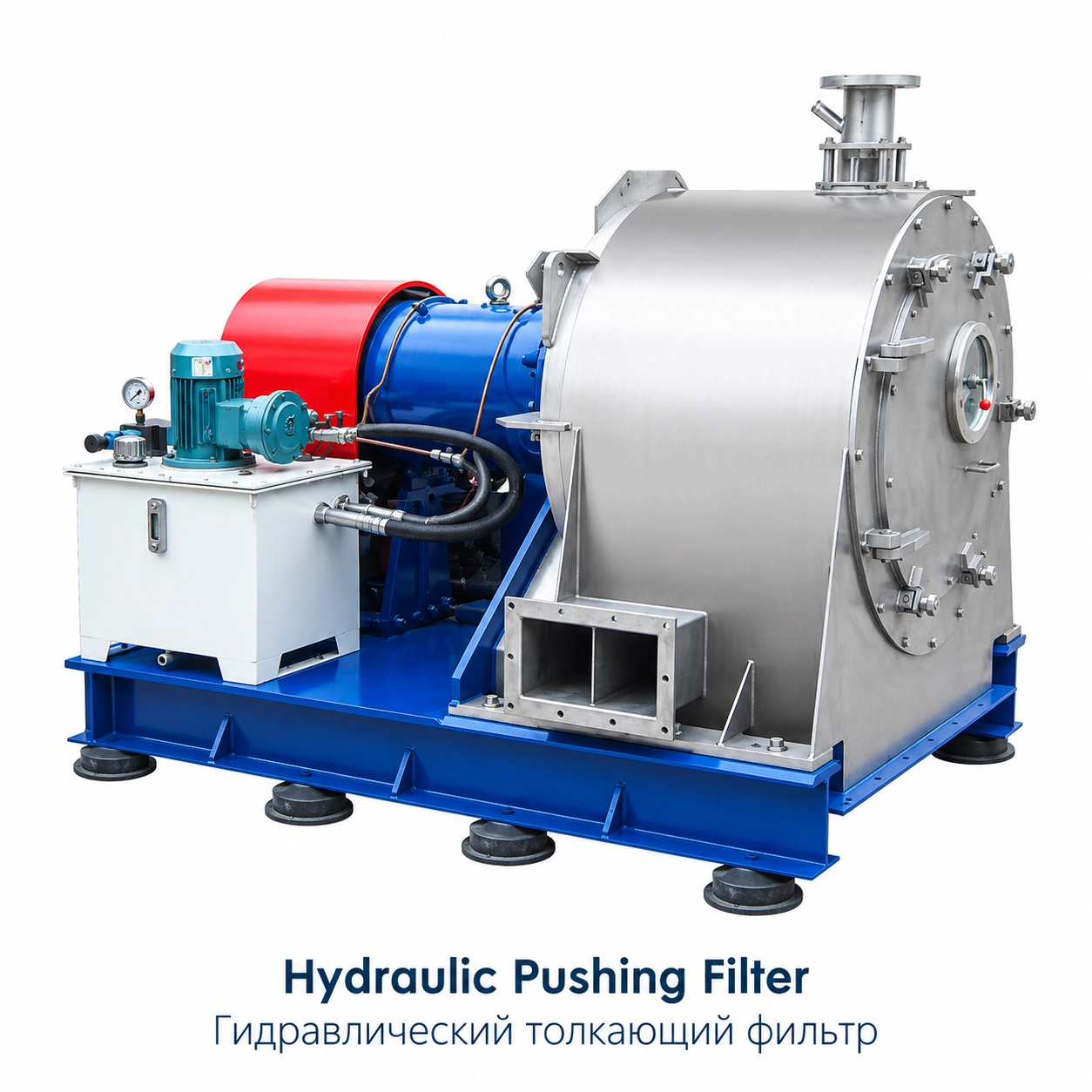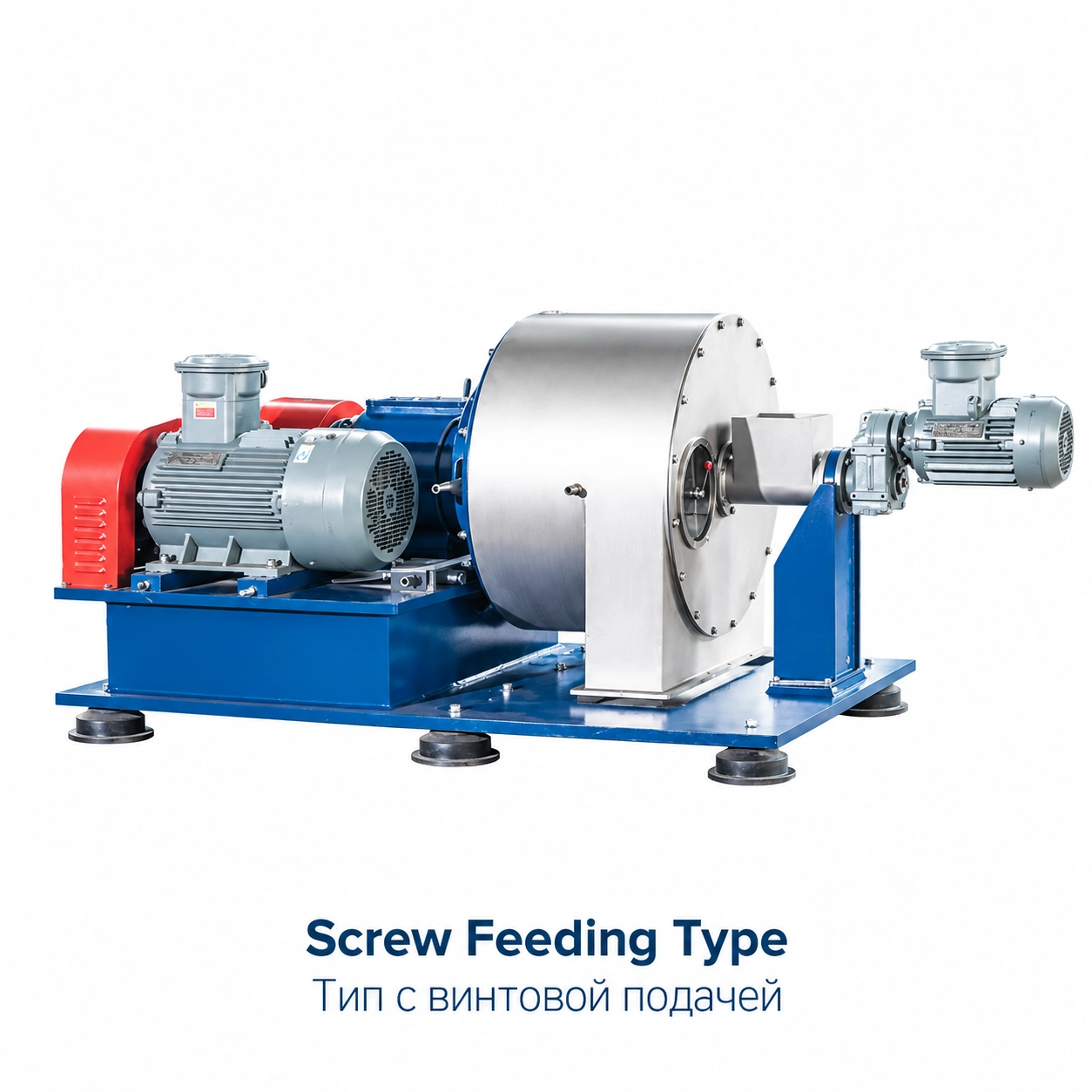

Crystalline and granular products
Filterable crystals and particles where strict protection against particle breakage is not required.
Continuous thickening and filtration
Continuous solid-liquid separation combining centrifugal pre-thickening with screen filtration for low-solids feeds, fine-particle recovery and enhanced final dewatering. Designed and manufactured for crystalline and granular products and fibrous and agricultural materials. Review the working principle, performance features and available configuration details below when specifying your industrial project.
Product Essentials
Select a topic from the directory. The content stays in one focused workspace for faster comparison.
Thickening and Filtration Screen-Worm Centrifuge Technical Data
Reference performance values for the six thickening and filtration screen-worm centrifuge configurations. Confirm material conditions and final configuration before selection.
| Model | Bowl diameter — sedimentation / filtration (mm) | Bowl speed (r/min) | Separation factor — sedimentation / filtration | Throughput — sedimentation / filtration (m³/h) | Solids output (t/h) | Main motor power (kW) | Machine weight (kg) | Overall dimensions (mm) |
|---|---|---|---|---|---|---|---|---|
| Model 1 | 400/350 | 3000 | 2016/1765 | 1–5 | 0.5–1.5 | 22 | 1400 | 1650 × 1430 × 1000 |
| Model 2 | 500/450 | 2500 | 1750/1575 | 2–8 | 1–3 | 30 | 1800 | 1800 × 1400 × 1250 |
| Model 3 | 550/520 | 1800 | 998/944 | 3–10 | 1.5–4 | 45 | 3400 | 2450 × 1700 × 1500 |
| Model 4 | 650/615 | 1600 | 930/882 | 5–15 | 2–6 | 55 | 4000 | 2650 × 1700 × 1600 |
| Model 5 | 800/740 | 1500 | 1007/932 | 8–20 | 4–8 | 75 | 5000 | 3000 × 2200 × 2000 |
| Model 6 | 900/650 | 1200 | 725/524 | 10–25 | 6–12 | 75 | 7000 | 3000 × 2200 × 2000 |
Source reference values. Sedimentation / filtration ranges indicate the supplied dual-duty data; final dimensions, materials and performance are confirmed during engineering.
Applications
Applications include crystalline and granular products and fibrous and agricultural materials. Confirm material properties and process conditions before selecting the equipment configuration.
Filterable crystals and particles where strict protection against particle breakage is not required.
Fibrous solids, crop hulls and similar materials with suitable filtration behavior.
Plastic particles and related process solids requiring continuous separation and dewatering.
Mother liquors with low solids concentration, a proportion of fine particles or a limited amount of viscous material.
Chemical, food, salt, mining and pharmaceutical processing.
Working Principle
The process route is selected around the material and product targets.
Feed enters the inner scroll and is distributed into the high-speed sedimentation section, where most of the liquid is separated from the solids.
The substantially clarified liquid exits through an adjustable bowl-overflow arrangement that sets pond depth and thickening conditions.
The internal scroll continuously conveys the concentrated suspension into the screen section, where residual liquid passes through the filter medium.
An optional wash pipe can provide a simple solids wash before centrifugal dewatering is completed.
The outer scroll transports the dewatered solids continuously into the discharge chamber.
Filtrate may be discharged separately, recirculated or combined with another liquid stream; an optional gas–liquid separator supports stable drainage.
Performance Highlights
Final performance remains dependent on feed properties and engineering confirmation.
Centrifugal sedimentation removes most of the liquid before the solids reach the screen.
Pre-concentration improves screen loading and makes the machine suitable for feeds with low initial solids.
The combined route supports recovery of fines that can be difficult for filtration-only machines.
Secondary screen filtration and centrifugal dewatering reduce liquid remaining in the discharged solids.
Continuous feed, separation and discharge support high throughput with strong conveying torque and reduced blockage risk.
An enclosed structure, VFD control, low vibration and low noise support efficient production with reduced emissions.
PLC control and optional adaptive hydraulic differential compensation respond to changing equipment load and separation conditions.
A broad selection of stainless steels, duplex alloys, titanium and nickel alloys supports corrosive or hygiene-sensitive duties.
Machine-condition monitoring and project-specific interlocks support reliable long-term operation.
System Configuration
Core equipment and auxiliary systems are selected around the process duty.
A sedimentation pre-thickener removes bulk liquid before the concentrated solids enter the screen-filtration section.
The overflow arrangement sets pond depth and allows the thickening condition to be matched to the feed.
The internal scroll transfers concentrated solids to filtration, while the outer scroll conveys the dewatered product to discharge.
Multiple differential systems, including an optional hydraulic drive with adaptive compensation, can match scroll speed to process load.
VFD control and PLC automation support stepless speed adjustment, load response and stable continuous operation.
The operating range is selected for the material and confirmed for the quoted configuration.
Different filtration media, feed systems and lubrication arrangements are available to suit material and operating requirements.
The operating range is selected for the material and confirmed for the quoted configuration.
Filtrate can be routed separately, recirculated or combined, with an optional gas–liquid separator for reliable drainage.
Speed, vibration, motor overload and overtemperature, and bearing temperature can be monitored; hazardous-area protection is available where required.
Selection Support
Share the following process information for an efficient preliminary review.