

Gravimetric filling controls a delivered mass. It does not, by itself, establish the volume in a bottle or show that every fill meets an agreed limit. Before comparing liquid-filling lines, identify the quantity being purchased, how the empty container is accounted for, and how the trial will distinguish an average from individual results.
The MOS weighing-filling and capping line provides a real equipment route for this discussion. Its catalogue lists an average filling accuracy and online checkweighing, but does not document the conditions behind that average. Treat those entries as questions for the offered configuration, rather than a validated single-bottle acceptance limit.
Decide which quantity the trial must establish
A purchase specification should say whether the acceptance quantity is net mass, volume at a stated temperature, or another explicitly defined measure. Bottle fill height is a separate observation: container geometry and foam can change its appearance without providing a reliable quantity measurement.
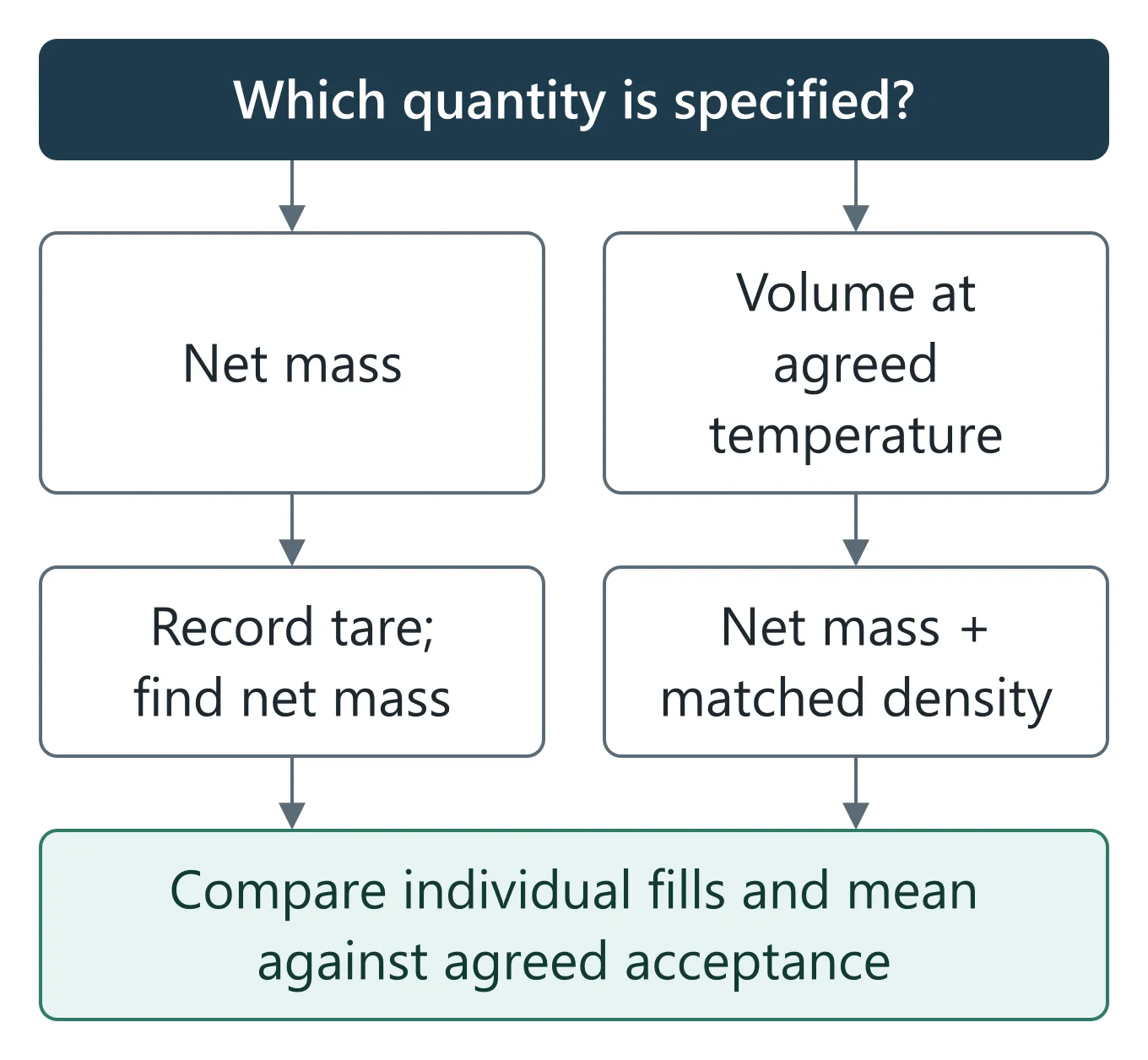
For a mass-based check, distinguish the filled container's gross mass from the liquid's net mass. The difference is the tare assigned to that container and to any other items included in the weighing. If a cap or label is present during one measurement but absent during another, the two records do not have the same boundary.
OIML R 61-1:2017 distinguishes tare determination from a preset tare. In practical purchasing terms, ask whether the proposed process measures each empty container, uses a validated group value, or applies another documented approach. Do not assume a catalogue reference to checkweighing answers that question.
A variable bottle mass can appear as variable liquid quantity when an unsuitable fixed tare is subtracted. Conversely, separately weighing an empty bottle does not remove all measurement uncertainty. Agree the container population, weighing sequence, control instrument and treatment of closures before the trial. These are qualification questions, not a claim that the MOS line includes a particular tare algorithm.
Convert to volume only on a defined density basis
If a volume requirement is assessed using a mass result, the conversion is V = m / ρ, where m is net product mass and ρ is the corresponding product density. Use consistent units. Density must describe the actual formulation at the specified temperature and state, not a convenient value for water or a different product.
For the same delivered mass, a higher density gives a smaller calculated volume. Therefore, stable mass readings do not prove stable volume when the relevant density changes. Record how density was determined, its applicable temperature and how the acceptance calculation handles product variation. Do not insert a generic temperature correction without a justified method.
This does not make gravimetric filling unsuitable for a volume-declared product. It means the conversion and its uncertainty belong in the qualification record. Nor does a volumetric method eliminate qualification: the METTLER TOLEDO filling discussion identifies material properties and flow conditions as important considerations. Its equipment claims are not MOS performance evidence.
Keep the average and individual fills visible
An average close to the target can coexist with fills above and below it. Two trials can share the same average while having different spreads. Ask for the individual results as well as the summary, and identify the target quantity used in any percentage-error calculation.
OIML R 61-2:2017 treats individual-fill mass, mean fill and preset-value error separately. Its test framework is useful context; citing it does not establish certification, a legal tolerance or conformity of the offered MOS line.
| Record | Interpret | Limit |
|---|---|---|
| Net fills + tare | Fill variation or a container contribution | Not a root-cause proof |
| Mean + spread + error basis | Centre and dispersion | Not every-fill acceptance |
| Product state + temperature + density method | Mass or converted volume | No universal correction |
| Actual rate + container + operating state | Tested scope | No untested-rate or formulation guarantee |
Include representative starts, restarts and steady running where they matter to the intended duty. Record interventions and rejected or held containers, rather than reporting only a favourable sequence. A trial at a reduced rate should remain identified as such. Product foaming, flow interruptions or an unstable weighing environment are reasons to investigate the test conditions, not to conceal excursions inside a mean.
Put acceptance before the quoted accuracy
For the actual liquid-line enquiry, provide the formulation and relevant flow behaviour, container and closure details, target net quantity, intended rate, and any density-based volume requirement. Ask the supplier to identify the weighing stages, tare treatment and the conditions supporting the stated accuracy.
Agree the sampling record, control measurement and separate mean/individual acceptance criteria before comparing proposals. Confirm applicable destination-market requirements independently; this guide supplies no universal legal limit. Add the required configuration, utilities, cleaning/material-contact needs, quantity and delivery destination to the commercial request. Purchase a line against a defined, interpretable trial—not an unexplained accuracy percentage.