

Washing a crystal cake is a trade-off to qualify, not a promise that more wash liquid always gives better product. A pusher-centrifuge trial should answer two questions together: has the required impurity been reduced, and how much valuable product has left with the liquid or fines?
The MOS continuous two-stage pusher filtration centrifuge is a real route for reviewing suitable crystalline-slurry duties. The offered configuration and feed still need qualification. A catalogue machine description cannot specify the wash ratio, recovery or purity for an untested material.
Decide what the wash step must remove
In its pusher-centrifuge operation guidance, ANDRITZ describes applying wash liquor to the advancing cake to displace suspension liquid and impurities. This is process context, not evidence that a MOS machine has that manufacturer's proprietary feeder, performance or exact internal arrangement.
Identify the unwanted constituent and where it resides. An impurity in retained mother liquor presents a different question from an insoluble contaminant or a constituent within the crystals. A displacement-wash proposal should not be assumed to remove every kind of contamination.
Agree the product analysis and its reporting basis before testing. A wetter cake can appear to have a lower concentration simply because the denominator changed. Conversely, a lower moisture result does not show that a particular chemical impurity was removed. Compare the agreed impurity on a consistent basis and measure residual liquid separately.
Put the samples inside one accounting boundary
Identify representative feed, discharged cake and collected liquid samples over a corresponding operating period. Use a sufficiently steady condition, or account for changes in material held inside the equipment across that period. State which filtrates are collected together and which can actually be sampled separately on the proposed configuration. Do not assume the machine provides independent mother-liquor and wash-filtrate outlets merely because that would simplify a worksheet.
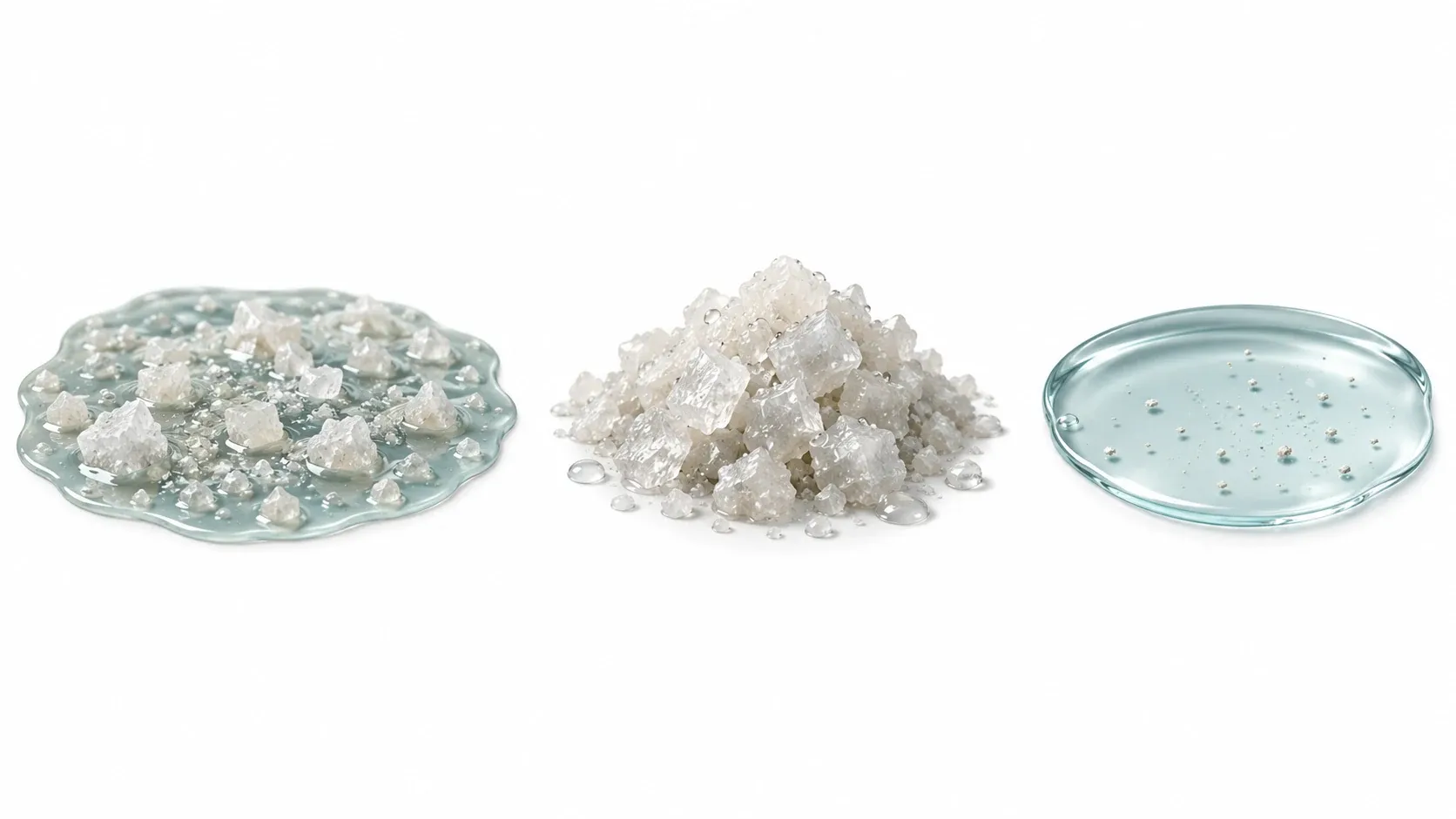
Feed and wash inputs
Record feed composition and dry-solids loading. Volumetric slurry flow alone does not establish the mass of solids entering during the period. Record wash-liquid quantity and composition separately; state consumption per dry solids and include relevant material introduced with the wash.
Cake at discharge
Measure the agreed impurity and residual liquid as separate items. Keep sample collection, conditioning and analytical basis comparable. A change in wet-cake dilution must not masquerade as impurity removal.
Collected liquid
Measure valuable material leaving in the collected liquid. Distinguish dissolved target substance from carried suspended fines using an agreed sampling and analytical method. The proposed equipment's actual collection arrangement determines which streams can be assessed independently.
Define recovery explicitly. Recovery of crystalline solids is not automatically the same as recovery of the total target substance across solid and liquid phases. If the wash introduces that substance, include the input. An unexplained balance discrepancy is a reason to check sampling and analysis, not to label the machine inefficient or declare a high recovery.
Change the wash condition, not the whole trial
Start from a documented reference condition. Keep feed composition, particle-size distribution, solids concentration, temperature and relevant operating settings controlled or recorded. Change one defined wash condition at a time, within the equipment and material procedure agreed for the project.
More wash may reduce retained mother liquor, but it can also increase liquid handling or dissolve valuable material where the wash and product permit that. The extent is material- and condition-dependent. A universal wash ratio or a temperature recommendation would conceal the question the trial must answer.
Compare purity, valuable-product loss, cake handling and wash consumption together. Record the liquid analysis rather than interpreting a clear-looking filtrate as proof of negligible loss: dissolved material is not identified by appearance alone. Likewise, an attractive dry-cake result does not establish sustained throughput, long-term screen behaviour or the performance of a different feed.
End with an acceptance envelope
Before testing, agree acceptable impurity, residual liquid, product recovery, wash consumption and sustained dry-solids throughput for the intended duty. Stop the selection if a required endpoint fails or sample identity, reporting basis or accounting remains unresolved. A passing screen qualifies the tested condition for the next project step; it is not a family-wide guarantee.
Send the pusher-centrifuge enquiry with feed and crystal information, liquid properties at operating temperature, required impurity reduction, wash-liquid constraints, sampling needs and acceptance criteria. Include sample availability, proposed duty and destination. Request a documented configuration and trial scope before comparing offers on one advertised purity or capacity number.