

A die opening is a tooling dimension, not a guarantee of the final dried pellet diameter. Wet extrudate, rounded wet pellets and dried/classified product are different material states. A quotation that says only “pellet size” leaves an important acceptance question unanswered.
For an equipment buyer, the useful starting point is the product that must be accepted at the end of the agreed process. Work back from that requirement to the trial and tooling; do not assume that a catalogue dimension at an earlier stage is the same measurement.
Name the product state you intend to accept
State whether the requirement applies to wet extrudate, rounded material, or dried and conditioned product after the agreed classification step. Name the dimensional method and the permitted distribution or fractions, not only an attractive target diameter.
Shape also matters. A cylindrical extrudate can have a cross-sectional dimension and a length; neither is automatically a complete description of rounded particles. Agree whether the acceptance evidence is based on sieving, image analysis or another suitable method. Results expressed through different definitions should not be treated as interchangeable simply because each uses a length unit.
Follow the material through four stages
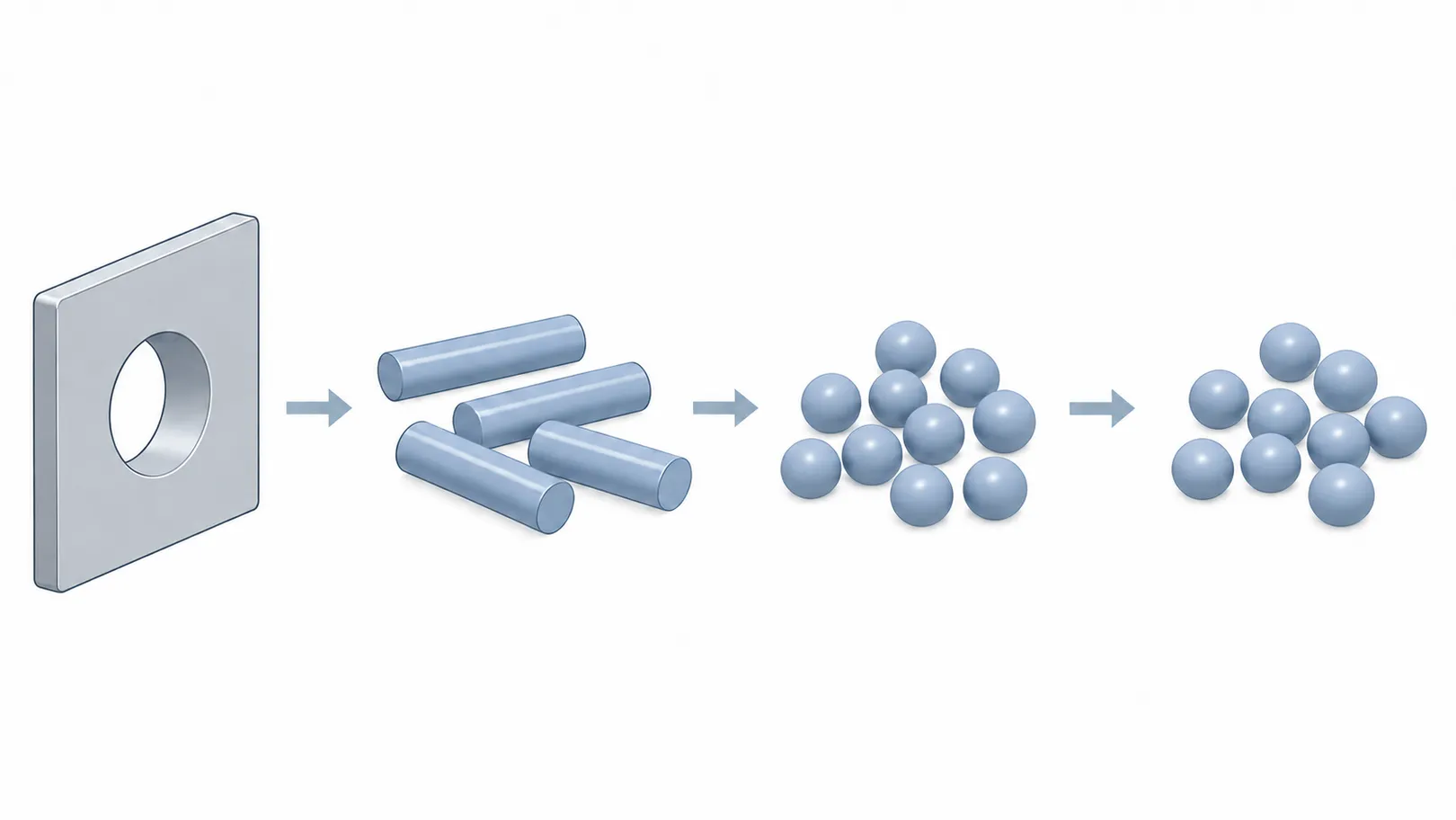
The illustration separates material forms. The table below supplies the records that an illustration cannot: what was sampled, what was measured, and the state to which the result belongs.
| Stage | Record the dimension as | Retain in the sample record |
|---|---|---|
| Die/tooling | The identified opening and relevant tooling specification | Tooling identity and revision; do not label it as a final product result |
| Wet extrudate | The agreed cross-section and, where relevant, length or shape measure | Material/formulation identity, moisture basis and sampling state |
| Rounded wet material | The agreed particle-size and shape evidence before drying | The defined rounding stage and material state |
| Dried/conditioned, classified product | The agreed final dimensional distribution and permitted fractions | Conditioning, classification and measurement method used for acceptance |
Caleva's die-selection guidance treats the opening as a starting point and explains why material, water and subsequent processing matter. Its examples are not conversion factors for MOS equipment. The accompanying spheronization primer describes the general sequence; it does not validate a particular MOS configuration.
Why the same opening can give a different final size
The material has to pass through the opening in a state that can be processed. Its formulation and wet-mass behaviour affect that step. The extrudate is then changed into a different shape during rounding, and drying can change its dimensions again. These are reasons to measure the stages, not a licence to prescribe a universal shrinkage percentage.
The tooling geometry also has more information than a single nominal opening. Compare the identified tool and relevant geometry under the intended material trial rather than assuming that matching one number establishes equivalent output. Do not infer the final distribution from the appearance of a few selected particles.
If a supplier reports cylindrical granules and another reports rounded product, first ask which stages and methods the numbers describe. Neither description alone proves that one machine will meet the other's product specification. The missing link is the agreed material/process trial and its final acceptance evidence.
Use a trial to locate the dimensional change
Agree the sampling and measurement plan before the trial. Retain separately identified records at the defined extrusion, rounding and final product stages, using the approved sampling arrangements for that trial. Keep the material identity, preparation and moisture basis attached to those records.
This lets the buyer ask a more useful question than “Is the die wrong?” A mismatch may already be present in the extrudate, may emerge during rounding, or may appear only after drying and classification. The records locate the stage that needs investigation; they do not automatically prove a cause.
When comparing trials, do not change formulation, tooling and downstream conditions together and then attribute the result to only one of them. Document the defined change and compare against the retained reference. Keep fines, oversize and other excluded fractions visible in the final acceptance record rather than showing only selected conforming pellets.
The distinction between a dimensional requirement and accepted net output is also important. The existing dry-versus-wet granulation guide covers the wider route and yield boundary. Here, the decision is narrower: which size definition and material state have actually been qualified?
Make the equipment enquiry stage-specific
MOS lists a Wet Screw Extrusion Granulator and an Organic Fertilizer Extrusion and Three-Stage Spheronization Granulator. They identify real equipment families; their catalogue dimensions and reference output figures do not replace a common project acceptance basis.
Send the material/application, the required final product state, the dimensional method and permitted distribution, the intended process stages, and the target accepted output basis. Include the trial scope and the proposed order destination. Ask the quotation to distinguish tooling dimensions from the final product requirement, and to identify which statements remain subject to the agreed material trial.