

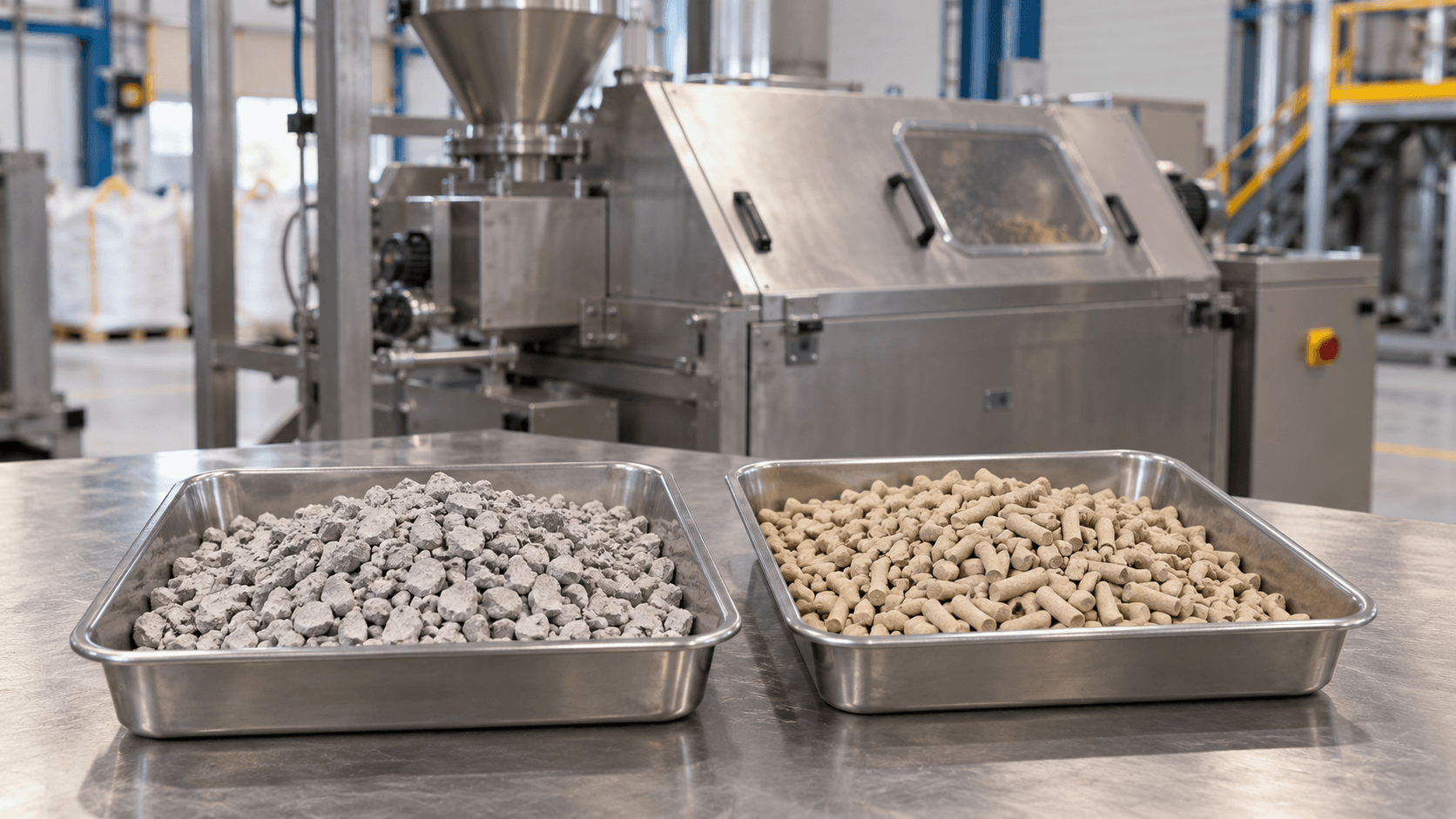
For a chemical or fertilizer powder, compare dry granulation and wet granulation by the feed you can process and the granules you can accept. Dry roll compaction avoids adding a granulating liquid; wet extrusion forms a conditioned mass. Neither description establishes capacity, strength or suitability for your material.
The double-roll dry granulator is a starting point for a dry-route inquiry. Compare it with the wet extrusion granulator after defining moisture, binder constraints and finished-product requirements. This guide concerns industrial powder processing; it does not establish pharmaceutical validation or application approval.
First decision: can the feed form an acceptable granule?
In roll compaction, powder is pressed between rolls; size reduction and classification can then produce the required granule fraction. In wet extrusion, a suitably conditioned feed passes through forming openings. The Alexanderwerk process reference describes the general distinction. Its equipment results are not specifications for a MOS machine.
A free-flowing powder is not necessarily compactable. Equally, a damp mass that passes through an opening has not yet demonstrated acceptable final granules. Before choosing a route, provide the feed composition, particle-size distribution, bulk density and measured moisture with its test basis. Identify sticking, caking or other handling problems from your current process rather than assuming a family name predicts them.
| Decision point | Dry roll compaction | Wet extrusion | Buyer confirmation |
|---|---|---|---|
| Feed behavior | Must form a usable compact and survive size reduction | Must form a workable conditioned mass | Test representative feed, not a generic powder |
| Liquid or binder | No granulating liquid added in this route; incoming moisture still matters | Conditioning liquid and any binder are part of the recipe | Confirm permitted additives and residual limits |
| Thermal constraints | Check feed temperature and any process heat | Assess any required drying with forming | Agree final moisture and material temperature limits |
| Finished product | Evaluate granule fraction, strength and fines after classification | Evaluate shape, size and integrity after final conditioning | Use the same acceptance methods |
| Capacity basis | Separate gross feed, recycle and accepted product | Separate forming rate from accepted finished output | Quote net on-spec output and line scope |
| Cleaning and construction | Confirm access, wear and contact-material requirements | Also assess wet residues and cleaning method | Specify material compatibility and changeover needs |
A dry route still needs a moisture and compaction trial
Avoiding a liquid-addition step does not mean that every incoming moisture level is acceptable, or that all upstream moisture management disappears. The current catalogue includes different material and configuration examples; they are not one universal moisture limit. Ask which feed range has been demonstrated for your material and what happens when its condition varies.
Use the dry roll compaction equipment page to prepare the trial request. Agree the sample condition, operating record and acceptance tests before the trial. A dry binder or other formulation change, if proposed, needs separate compatibility and product-approval review; do not treat “dry” as a guarantee of an unchanged formulation.
Compare accepted output, not headline throughput
Specify the accepted size fraction, strength or handling test, fines limit and measurement point. Record fresh feed, recovered product, rejected material and any recycle over an agreed trial period. A machine feed rate and the net quantity of accepted granules are different reporting bases. Likewise, a published yield for one material or granule form cannot determine your project guarantee.
For wet extrusion, check the product after any required drying or conditioning. If the downstream stage changes moisture, dimensions or handling integrity, evaluating only the fresh extrudate leaves the purchase decision incomplete. Alexanderwerk’s moist-granulation description supports conditioned-feed extrusion as a process concept, not a universal result for all wet materials.
Evaluate the complete route before sizing equipment
Ask whether the proposed scope includes feed preparation, liquid handling, forming, size classification, drying where needed, dust management and packaging interfaces. Confirm available utilities and temperature limits. Where solvents or hazardous dust may be present, obtain a project-specific safety and containment assessment; no explosion-protection certification or solvent-handling capability is implied here.
An extrusion unit alone does not establish drying capacity, just as a compactor alone does not establish accepted screened output. Material-specific granulation trials can compare operating settings and resulting particle properties. Agree which measurements your supplier will report and which conditions must be repeated during acceptance.
Send an RFQ that permits a comparable technical proposal
For a dry-granulation equipment RFQ or wet-extrusion equipment RFQ, provide material identity and composition; feed moisture and test basis; particle-size distribution and bulk density; required net accepted capacity and batch or continuous duty; target granule size, fines and strength tests; permitted binder or solvent; temperature constraints; cleaning and contact-material requirements; utilities and destination. Include your current process problem and the sample available for a trial.
Request a written configuration and trial proposal stating the line boundary, sample requirements, measurement methods and acceptance criteria. Confirm any throughput, moisture or strength commitment for the tested feed and agreed configuration. A catalogue comparison is a shortlist, not a substitute for that confirmation.
Granulation selection FAQ
Does dry granulation mean the feed must contain no moisture?
No. Here “dry” means no granulating liquid is added in the compaction route. Incoming moisture and its variability still affect selection. Confirm a material-specific feed range and test method rather than applying one catalogue limit to every powder.
Does wet extrusion always need a separate dryer?
Check the required final product and the proposed line. Many wet-granulation processes need drying, but the actual conditioning or drying requirement must be established from the feed, added liquid and final-moisture target. Do not assume an extruder quotation includes a dryer.
Which capacity should be compared in equipment quotations?
Compare net accepted finished granules over an agreed test period. State the size fraction, moisture endpoint, handling or strength test, rejection and recycle basis. Keep gross feed and forming rates separate from accepted finished output.
What should be confirmed before replacing one route with the other?
Trial the representative material and check formulation changes, permitted liquid or binder, thermal exposure, granule acceptance, cleaning, utilities and downstream interfaces. Obtain an agreed configuration and acceptance plan; there is no universal dry-to-wet replacement rule.