
Fertilizers
Potassium sulfate, potassium chloride, Russian red potash, compound fertilizers, ammonium chloride, potassium nitrate, monoammonium phosphate, diammonium phosphate, ammonium sulfate and ammonium bicarbonate.
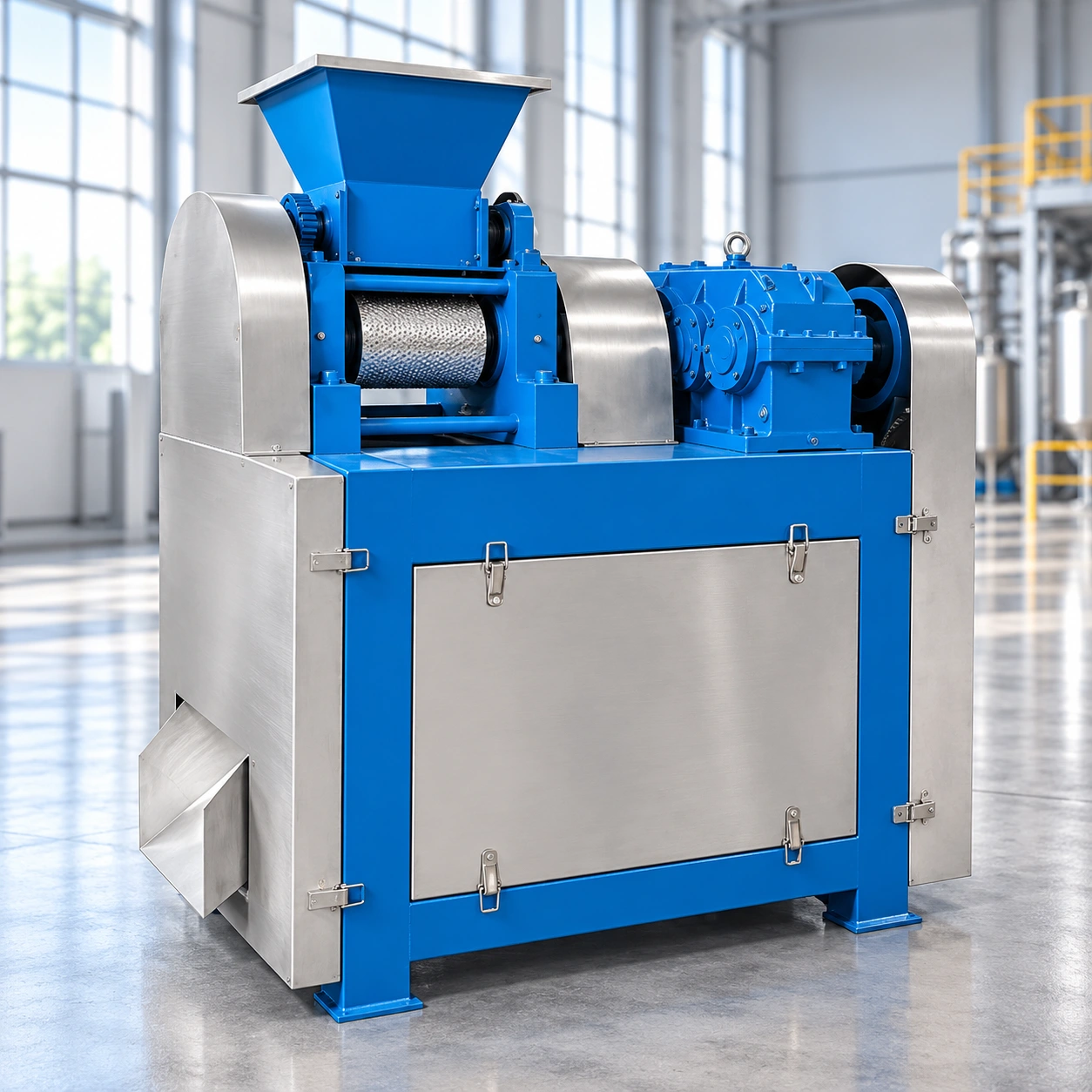
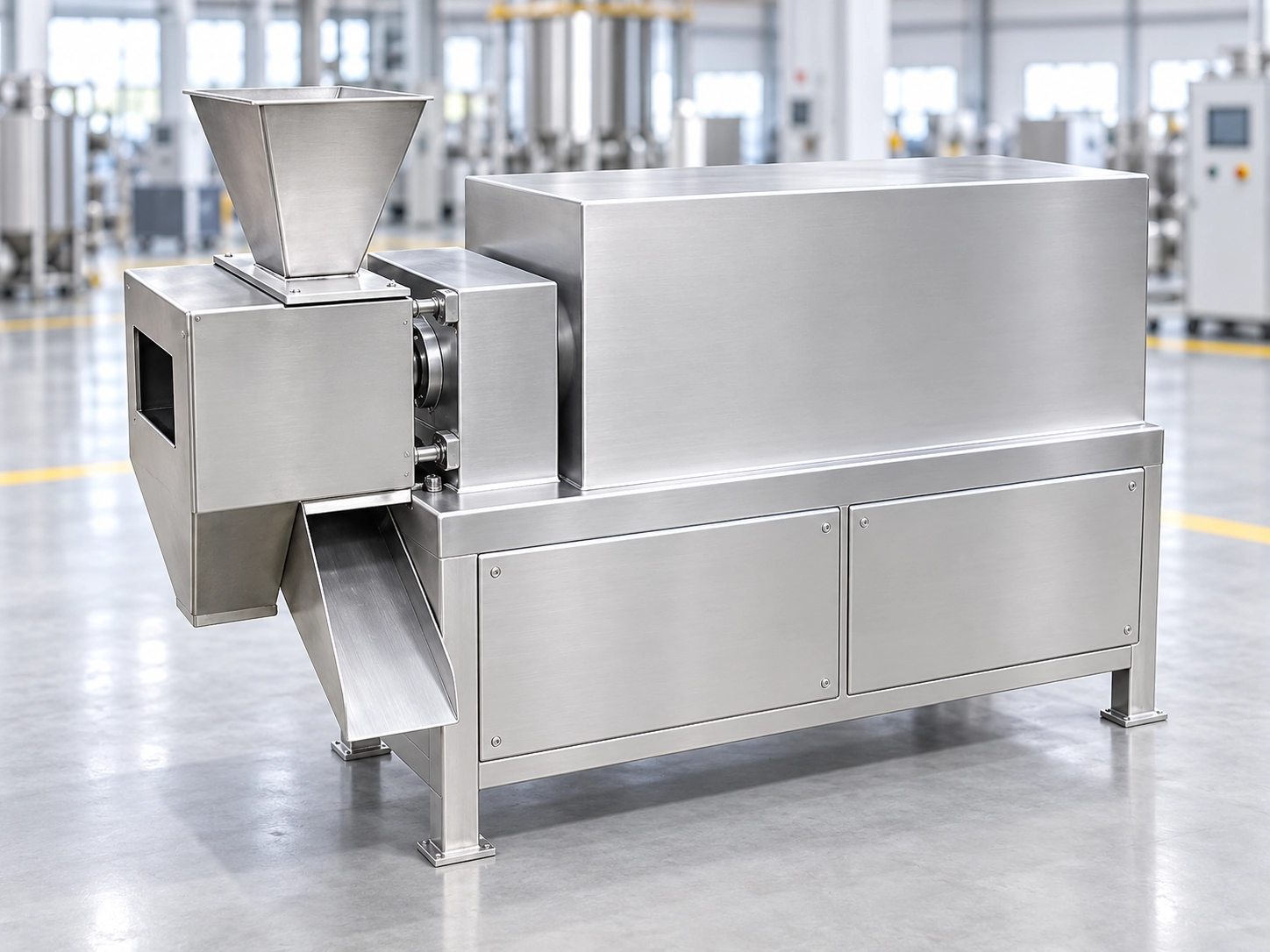
Dry Roll Compaction Granulator
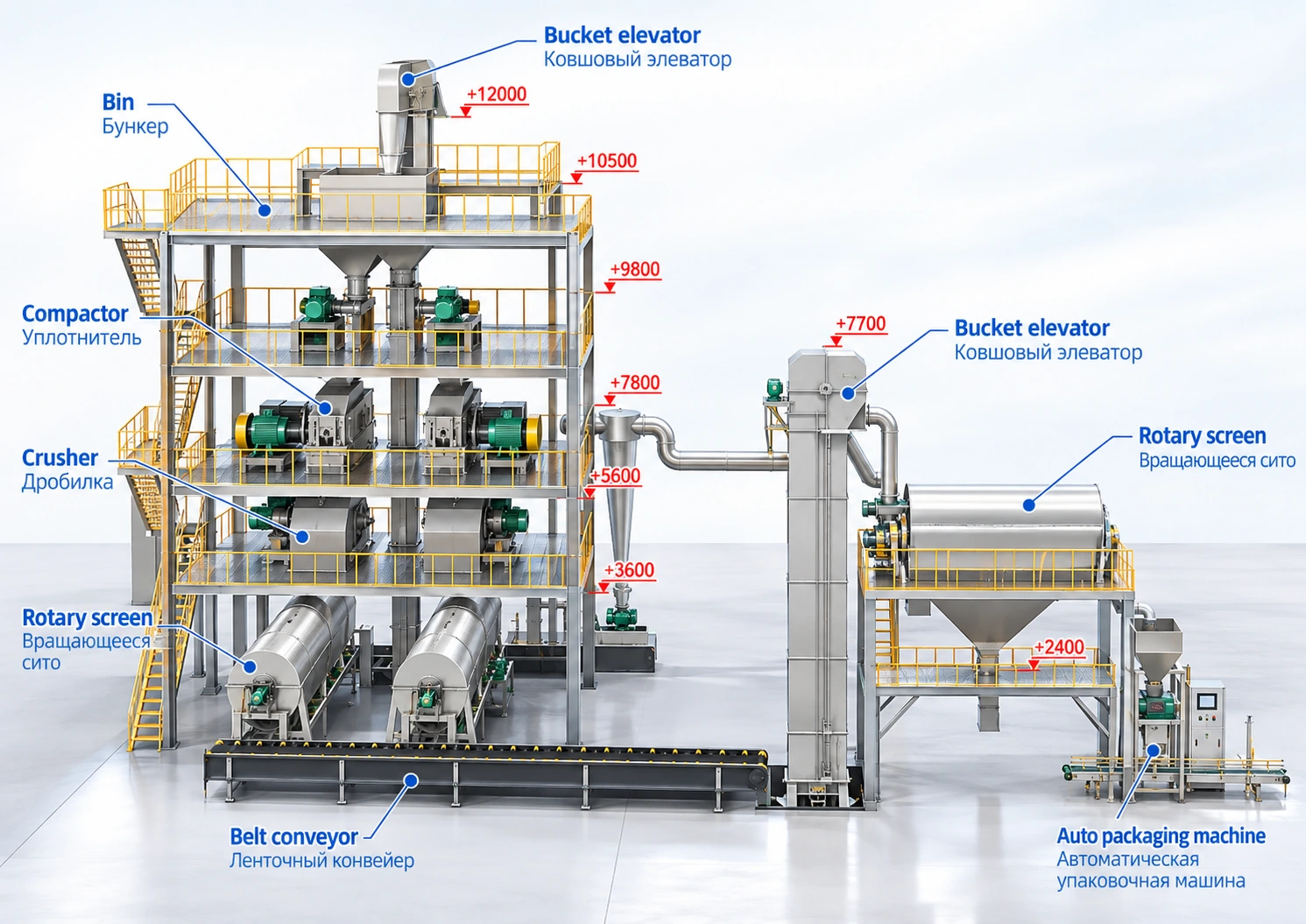
The Dry Roll Compaction Granulator continuously converts powder with less than 5% moisture into uniform granules through feeding, roll compaction, crushing, screening and recycling. Designed and manufactured for fertilizers and inorganic salts and treatment chemicals. Review the working principle, performance features and available configuration details below when specifying your industrial project.
Product Essentials
Select a topic from the directory. The content stays in one focused workspace for faster comparison.
Application and Technical Data
Listed values apply to the identified configuration. Confirm material conditions, utilities and optional equipment before selection.
| Material | Roll diameter (mm), in output order | Required granule size (mm) | Reference output by listed roll diameter (kg/h) |
|---|---|---|---|
| Potassium chloride / Russian red potash | 360, 450, 650, 850, 1050, 1250, 1500 | 2.0–4.75 | 1,000–1,500; 2,000–2,600; 3,200–4,500; 6,000–8,000; 12,000–16,000; 18,000–25,000; 35,000–50,000 |
| Potassium sulfate | 360, 450, 650, 850, 1050, 1250, 1500 | 2.0–4.75 | 1,000–1,300; 2,000–2,500; 3,000–4,500; 6,000–8,000; 12,000–16,000; 18,000–25,000; 35,000–50,000 |
| NPK compound fertilizer | 360, 450, 650, 850, 1050, 1250, 1500 | 2.0–4.75 | 900–1,500; 1,800–2,600; 3,000–4,500; 6,000–8,000; 12,000–16,000; 18,000–25,000; 35,000–50,000 |
| Cryolite | 360, 450, 650, 850, 1050, 1250, 1500 | 2.0–4.75 | 1,000–1,500; 2,000–2,600; 3,200–4,500; 6,000–8,000; 12,000–16,000; 18,000–25,000; 35,000–50,000 |
| Ammonium chloride / ammonium sulfate | 360, 450, 650, 850, 1050, 1250, 1500 | 2.0–4.75 | 800–1,000; 1,800–2,500; 3,100–4,600; 6,000–8,000; 12,000–16,000; 18,000–25,000; 35,000–50,000 |
| Antioxidant | 360 | 0.3–2.0 | 300–400 |
| Zinc oxide | 360 | 1.5–2.5 | 350–500 |
| Sodium cyanide | 360 | 1.5–6.0 | 800–1,000 |
| Steelmaking additive | 360 | Olive-shaped | 1,000–1,200 |
| Deicing agent | 360 | 2.0–7.0 | 800–1,000 |
| Bromochlorohydantoin | 240 | 1.5–6.0 | Approx. 300 |
| Pharmaceutical intermediate | 240 | 0.5–2.0 | Approx. 200 |
| Environmental intermediate | 240 | 8.0–15.0 | Approx. 500 |
| Parameter | Roll diameter: Φ240 mm | Roll diameter: Φ360 mm | Roll diameter: Φ450 mm | Roll diameter: Φ650 mm |
|---|---|---|---|---|
| Roll diameter (mm) | Φ240 | Φ360 | Φ450 | Φ650 |
| Effective roll width (mm) | 300 | 170–230 | 190–280 | 290–330 |
| Roll speed (rpm) | 50–100 | 10–25 | 10–25 | 10–25 |
| Maximum flake thickness (mm) | 4 | 8 | 12 | 16 |
| Flake capacity (kg/h) | — | 1,300–2,300 | 2,500–3,500 | 5,000–7,000 |
| Finished-granule capacity (kg/h) | 2,000–3,000 (oblate) | 900–1,300 | 1,800–2,500 | 3,500–4,000 |
| Finished granule size (mm) | 3.5 / 4.2 / 4.5 / 5.5 / 6.5, etc. | 2–5 | 2–5 | 2–5 |
| Main motor power (kW) | 45 | 30–37 | 55–75 | 90–110 |
| Total installed power (kW) | 55 | 55 | 90 | 175 |
| Overall dimensions, L × W × H (mm) | 2300 × 1700 × 1860 | 2350 × 2000 × 2600 | 2600 × 2200 × 2900 | 3600 × 2800 × 3200 |
| Total equipment weight (t) | 5 | 7 | 10 | 21 |
| Parameter | Roll diameter: Φ850 mm | Roll diameter: Φ1050 mm | Roll diameter: Φ1250 mm | Roll diameter: Φ1500 mm |
|---|---|---|---|---|
| Roll diameter (mm) | Φ850 | Φ1050 | Φ1250 | Φ1500 |
| Effective roll width (mm) | 420 | 450 | 500 | 650 |
| Roll speed (rpm) | 9–16 | 8.5–14.5 | 6–13 | 6–13 |
| Maximum flake thickness (mm) | 25 | 36 | 36 | 36 |
| Flake capacity (kg/h) | 12,000–16,000 | 22,000–38,000 | 36,000–50,000 | 64,000–200,000 |
| Finished-granule capacity (kg/h) | 6,000–8,000 | 12,000–16,000 | 18,000–25,000 | 35,000–50,000 |
| Finished granule size (mm) | 2–5 | 2–5 | 2–5 | 2–5 |
| Main motor power (kW) | 220–250 | 400 | 630 | 400 × 2 |
| Total installed power (kW) | 400 | 850 | 1,000–1,200 | 1,500–1,800 |
| Overall dimensions, L × W × H (mm) | 5000 × 3800 × 4100 | 5500 × 6400 × 4800 | 7500 × 6500 × 5200 | 9700 × 5600 × 7700 |
| Total equipment weight (t) | 46 | 98 | 100–120 | 120–150 |
Application outputs correspond to the listed models in the same left-to-right order. Flake capacity and finished-granule capacity are reference values only; actual output depends on material properties, process conditions and operating practice. Final specifications require material testing and engineering confirmation.
Applications
Applications include fertilizers and inorganic salts and treatment chemicals. Confirm material properties and process conditions before selecting the equipment configuration.
Potassium sulfate, potassium chloride, Russian red potash, compound fertilizers, ammonium chloride, potassium nitrate, monoammonium phosphate, diammonium phosphate, ammonium sulfate and ammonium bicarbonate.
Sodium chloride, sodium dichloroisocyanurate, trichloroisocyanuric acid, cyanuric acid, bleaching powder, potassium carbonate, barium carbonate, calcium chloride, dicalcium phosphate, sodium metasilicate and sodium orthosilicate.
Cryolite, aluminum fluoride, calcium aluminate, heavy calcium carbonate, single superphosphate, phosphate rock powder, metal powders, alumina powder, steelmaking additives and mineral-processing agents.
Antioxidants, bromochlorohydantoin, zinc oxide, rubber and plastics additives, precipitated silica, fillers and feed additives.
Pharmaceutical intermediates, environmental materials, phosphogypsum, desulfurization gypsum, graphite and carbon black.
Working Principle
The process route is selected around the material and product targets.
A variable-speed feeder supplies powder uniformly to the feed hopper.
The conical screw and agitator force the powder into the roll gap while releasing entrained air to improve roll bite.
Two rolls rotate at equal speed in opposite directions and continuously compress the powder under hydraulic pressure.
As the roll gap closes, the powder bulk volume decreases and its apparent density typically increases by approximately 1.5–3 times, forming mechanically strong flakes or briquettes.
The compacted material passes through two crushing stages and three crushing chambers to produce the required granule range.
The high-efficiency screen separates qualified product from fines and oversize material.
Nonconforming powder is conveyed back to the feeding system for reprocessing, while qualified granules are discharged.
Performance Highlights
Final performance remains dependent on feed properties and engineering confirmation.
Powder is granulated without added binder and without a downstream drying stage, simplifying plant integration and process modification.
Finished-granule strength can be controlled by adjusting hydraulic roll pressure to suit the material and product specification.
Long-duration continuous operation and automatic fines recycling improve effective throughput and material utilization.
Forced mechanical compaction substantially increases powder bulk density for products requiring denser handling and storage characteristics.
Quantitative and forced-feed devices use stepless frequency control for responsive process adjustment and higher automation.
A short process route, compact construction, straightforward operation and convenient maintenance reduce space, energy demand and downtime.
The dry closed-loop process reduces material waste and helps limit dust in the production environment.
An enlarged twin-output special gearbox and crowned-tooth coupling protect the rolls and main bearings while improving transmission efficiency.
A large access door positioned close to the rolls and a top operating platform simplify inspection, operation and maintenance.
Integral forged alloy-steel roll bodies, engineered wear layers, transition layers and heat treatment improve crack and wear resistance.
An online-adjustable gate and air-expansion chamber release entrained air and improve material bite at the rolls.
The modular hydraulic system provides multiple automatic protections; controlled movement of the floating roll helps protect the machine if tramp metal enters.
Operating parameters can be set and machine status monitored online to provide real-time production information.
Two-stage crushing and multi-motion screening increase sizing area and efficiency while maintaining low vibration, low noise and convenient screen replacement.
System Configuration
Core equipment and auxiliary systems are selected around the process duty.
Includes a mechanical vibrator with automatic, timed vibration control.
Uses variable-frequency speed control to regulate material feed rate.
Combines a variable-speed motor, conical screw, agitator blades and conical hopper for additional deaeration and pressure feeding.
Includes bearing housings, frame, two forged alloy-steel rolls, hydraulic cylinders and power unit, gearbox and main motor.
Breaks the compacted flakes or briquettes and controls granule size through a two-stage, three-chamber arrangement.
Separates finished granules from recyclable powder using combined circular, elliptical and reciprocating linear motion, with a screen-cleaning device.
Returns screened off-specification powder to the feeding system.
Transfers material between process stages.
Centralizes machine operation, parameter setting and operating-status monitoring.
Selection Support
Share the following powder, product and site data so roll geometry, pressure, feed system, screen and installed power can be confirmed.
Related Products