
Waxes, resins and bitumen
Paraffin wax, petroleum resin, C5 resin, C9 resin, C5/C9 copolymer resin and bitumen.
Melt Cooling and Solidification Granulator
The Rotary Steel-Belt Melt Condensation Granulator continuously converts molten thermoplastic and heat-sensitive materials into granules, strips or flakes on a water-cooled stainless-steel belt. Designed and manufactured for waxes, resins and bitumen and industrial chemicals. Review the working principle, performance features and available configuration details below when specifying your industrial project.
Product Essentials
Select a topic from the directory. The content stays in one focused workspace for faster comparison.
Technical Data
Listed values apply to the identified configuration. Confirm material conditions, utilities and optional equipment before selection.
| Belt width (mm) | Production capacity (kg/h) | Belt / distributor drive power (kW) | Overall length (m) | Reference weight (kg) |
|---|---|---|---|---|
| 600 | 100–400 | 1.5 / 2.2 | 18.2 | 1,500–3,000 |
| 1000 | 200–800 | 5.5 / 2.2 | 18.2 | 2,700–6,000 |
| 1200 | 300–1000 | 5.5 / 2.2 | 18.2 | 3,000–7,000 |
| 1500 | 500–1200 | 5.5 / 2.2 | 18.2 | 4,000–9,000 |
Production capacity depends on the actual material properties. Product particle size is engineered to the customer’s requirements. Final specifications are subject to process testing and engineering confirmation.
Applications
Applications include waxes, resins and bitumen and industrial chemicals. Confirm material properties and process conditions before selecting the equipment configuration.
Paraffin wax, petroleum resin, C5 resin, C9 resin, C5/C9 copolymer resin and bitumen.
Sodium sulfide, maleic anhydride, stearic-acid products, hot-melt adhesives and compatible additives.
Rubber auxiliaries, plastic additives, antioxidants and anti-aging agents.
Compatible light stabilizers, including types 622 and 944, subject to process verification.
Materials requiring condensation granulation with a melting or softening point of 250 °C or below.
Working Principle
The process route is selected around the material and product targets.
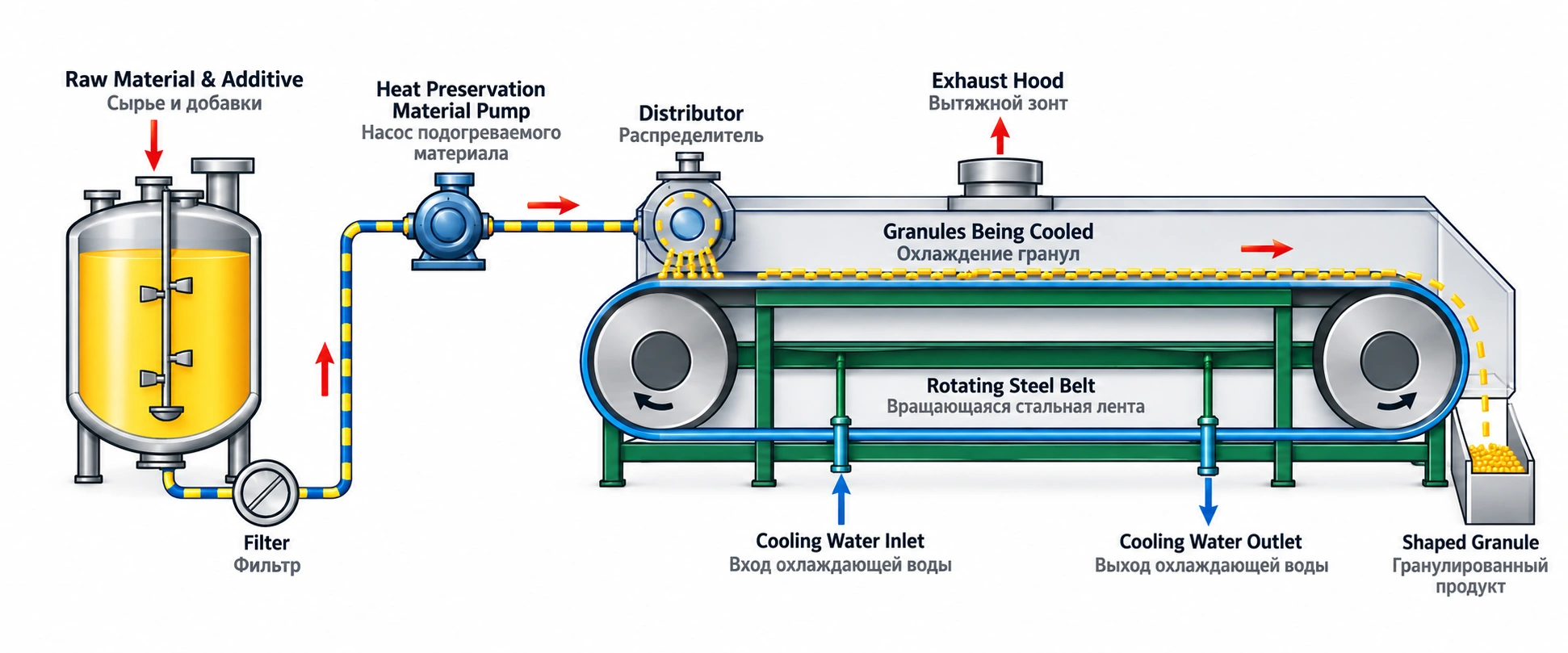
Hot molten material is transferred from the upstream process to the distributor.
The distributor applies the melt to the steel belt by intermittent dripping, continuous strip extrusion or full-width overflow.
The stainless-steel belt carries the distributed material through the cooling zone at a controlled speed.
Cooling water sprayed beneath the belt removes heat without direct contact with the product.
The melt cools and solidifies into hemispherical granules, strips or flakes according to the selected distribution mode.
The solidified product separates from the belt at the discharge end for collection or downstream handling.
Performance Highlights
Final performance remains dependent on feed properties and engineering confirmation.
The equipment is designed and manufactured under an ISO 9001-certified quality-management system stated to be applied to military-equipment production.
The hard, smooth belt provides high thermal conductivity and resistance to high and low temperatures; its length, width, thickness and surface finish can be selected for the duty.
Smooth, low-noise continuous operation supports high production efficiency and consistent product formation.
Controlled distribution and belt movement help produce regular, uniform and relatively small particles.
Cooling-water reuse helps reduce water consumption, limit dust and improve the production environment.
Frequency-controlled distributor and belt drives allow operating speed to be matched to material properties.
Intermittent dripping, continuous strip extrusion and full-width overflow produce hemispherical granules, strips and flakes respectively.
System Configuration
Core equipment and auxiliary systems are selected around the process duty.
Receives hot melt continuously from the upstream process.
Supports intermittent dripping, continuous strip extrusion or full-width overflow.
Provides a hard, smooth heat-transfer surface with selectable length, width, thickness and finish.
Continuously cools the underside of the belt while keeping cooling water separate from the product.
Allows process water to be recirculated to reduce consumption and support a cleaner operating environment.
Independently regulate distributor and belt speeds for process adjustment.
Releases the solidified granules, strips or flakes for collection.
Selection Support
Share the following melt, product and utility data so the distributor, belt and cooling system can be configured correctly.