
Catalysts
Wet extrusion and cylindrical forming of compatible catalyst formulations.
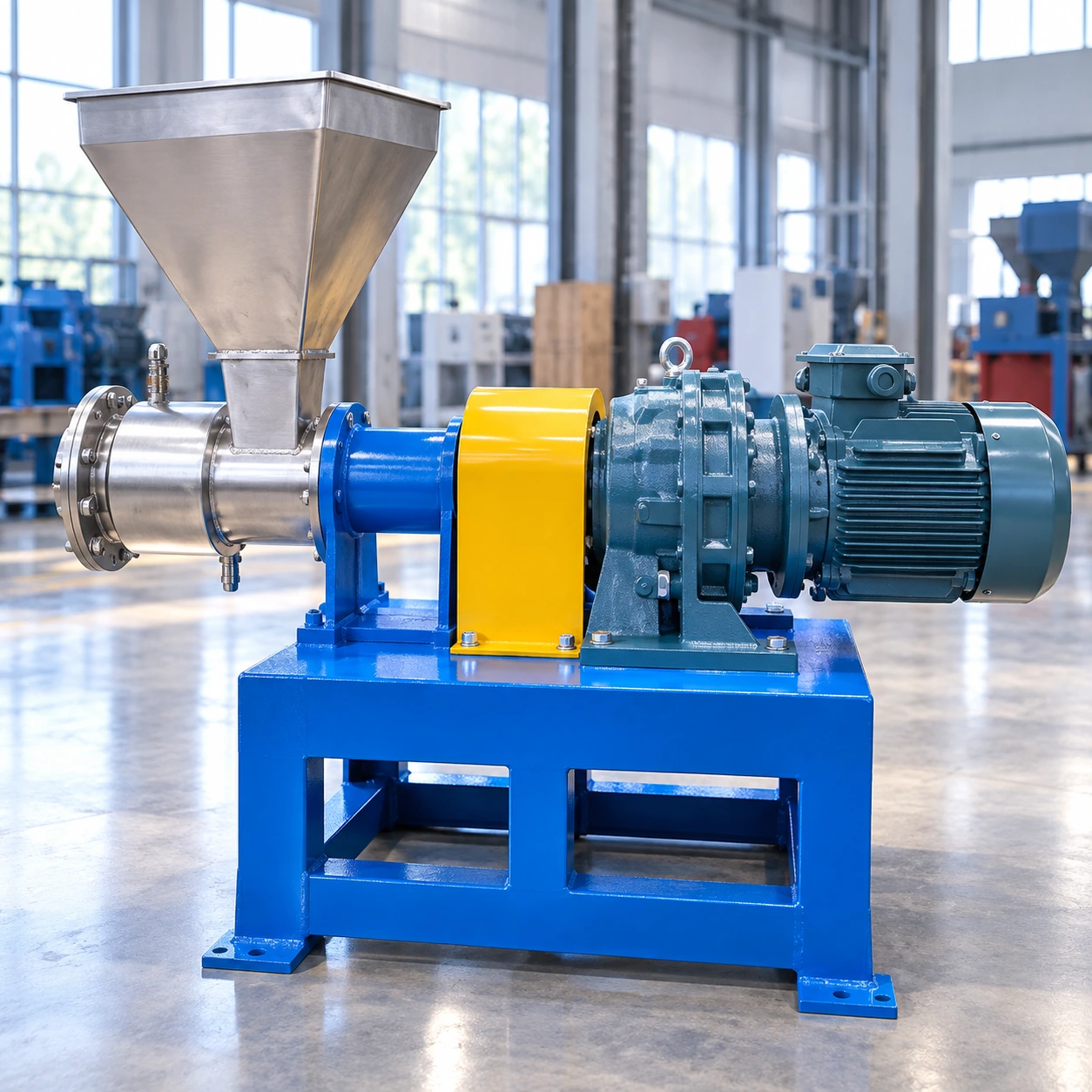
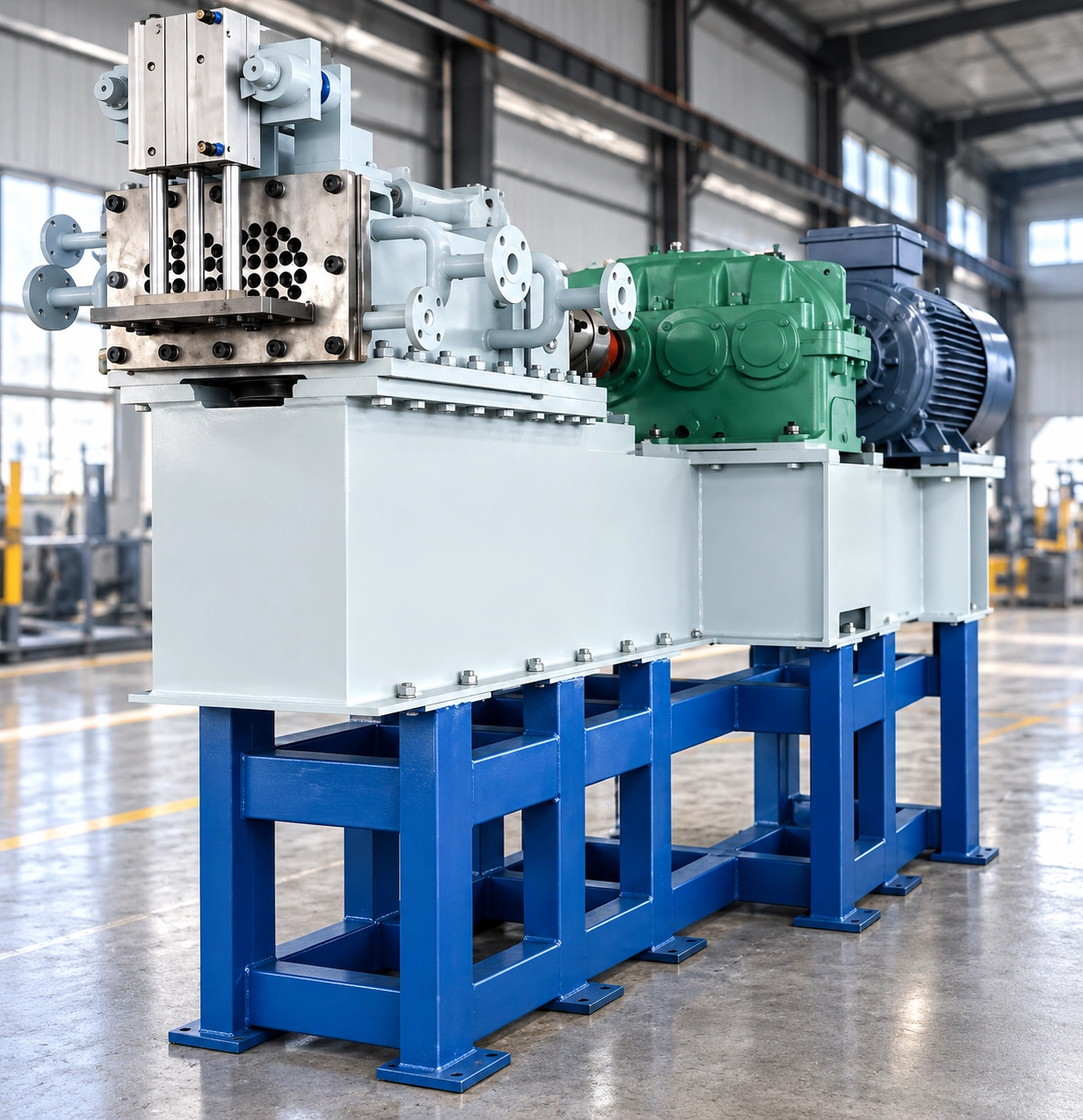
Wet Extrusion Granulator
The Intermeshing Gear Wet Extrusion Granulator continuously compacts suitable powder between counter-rotating gears and extrudes it through forming holes into uniform cylindrical granules. Designed and manufactured for catalysts and auxiliaries and additives. Review the working principle, performance features and available configuration details below when specifying your industrial project.
Product Essentials
Select a topic from the directory. The content stays in one focused workspace for faster comparison.
Technical Data
Reference pitch-circle diameter and drive-power values for the three intermeshing gear wet extrusion granulator configurations. Confirm material conditions and final configuration before selection.
| Model | Pitch circle diameter (mm) | Drive power (kW) |
|---|---|---|
| Model 1 | 100 | 7.5 |
| Model 2 | 180 | 15 |
| Model 3 | 360 | 30 |
Granulation yield and finished-product quality depend on formulation, feed moisture, binder, forming-hole diameter and operating conditions. Final equipment selection is subject to material testing and engineering confirmation.
Applications
Applications include catalysts and auxiliaries and additives. Confirm material properties and process conditions before selecting the equipment configuration.
Wet extrusion and cylindrical forming of compatible catalyst formulations.
Industrial auxiliaries and functional additives requiring strong, uniform granules.
Suitable household and personal-care chemical formulations after process evaluation.
Compatible pesticide formulations requiring controlled cylindrical granule size.
Additional wet powder systems with suitable cohesion, flow and extrusion behavior.
Working Principle
The process route is selected around the material and product targets.
Conditioned powder is introduced through the feed hopper and enters the tooth spaces.
The material is carried into the converging zone between the main and driven meshing gears.
The changing internal volume during gear engagement compresses the wet powder.
Developed pressure forces the compacted material through forming holes at the tooth roots.
The extrudate forms cylindrical granules of the selected diameter for collection or downstream processing.
Performance Highlights
Final performance remains dependent on feed properties and engineering confirmation.
Volume reduction between the engaging teeth compresses the feed and forces it through the root holes for continuous granule formation.
Designed for conditioned powder systems whose inherent cohesion or added binder supports extrusion.
Rapid tooth-space compression and discharge limit the duration of mechanical action on the material.
The published process produces mechanically strong granules with consistent length.
Forming-hole selection provides nominal product diameters from Φ2.0 to Φ8.0 mm.
Controlled extrusion produces cylindrical granules with a comparatively consistent specification.
The documented granulation yield is at least 95% under suitable material and operating conditions.
The machine can process compatible catalysts, auxiliaries, additives, daily chemical products and pesticides.
System Configuration
Core equipment and auxiliary systems are selected around the process duty.
Introduces conditioned powder uniformly into the gear tooth spaces.
Provides the primary driven surface for conveying, compressing and extruding the material.
Meshes with the main gear to create the changing volume and extrusion pressure.
Determines the nominal cylindrical granule diameter within the available Φ2.0–Φ8.0 mm range.
Synchronizes the gear pair and supplies the required torque.
Releases formed granules for subsequent drying, screening or packaging as required.
Selection Support
Share the following feed and product data so gear size, forming-hole pattern, construction and downstream equipment can be confirmed.
Related Products