

A continuous mixer's nominal volume and shaft speed do not establish how long every particle remains inside it. For procurement, separate a steady-state mean-time estimate from the spread of material residence times and from the quality of the discharged blend. The three questions need different measurements.
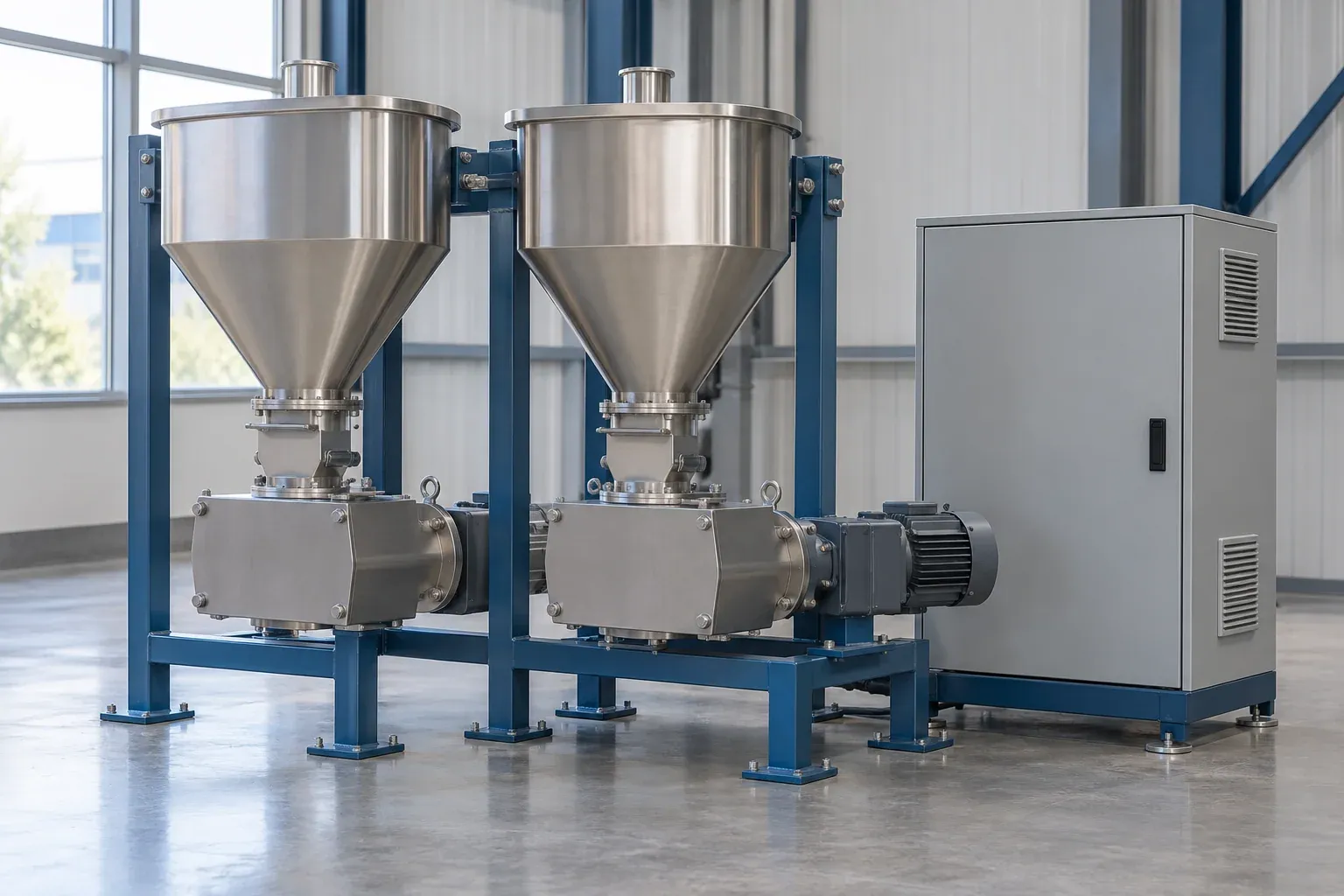
The real MOS continuous industrial mixer coordinates feeding, shaft speed and discharge. Its available agitator and optional equipment choices do not provide a measured residence-time distribution, a validated throughput or an installed control-system specification for a proposed project.
Mean residence time is not a minimum time
Under stable mass balance, a working material hold-up divided by mass throughput gives a mean residence-time estimate. Use actual material inventory, not the empty vessel's nominal litres. If inventory is recorded in kilograms and throughput in kilograms per minute, the estimate is in minutes. Bulk density, filling and flow conditions matter when inventory must be established from volume.
For a hypothetical stable process with 60 kg working hold-up and 20 kg/min throughput, the estimate is 3 minutes. This is arithmetic, not MOS test data. It does not prove that every portion receives at least 3 minutes of mixing, that no material is retained longer or that the blend meets its composition specification.
Track material through the process
Record the input streams, material held in the mixer and sampled discharge on a common timeline. Distinguish the set feed rate from the actual delivered mass flow. Coperion's feeding reference explains why gravimetric feeding can address bulk-density-related variations in continuous processes. It does not establish that a particular MOS quotation includes such feeders.
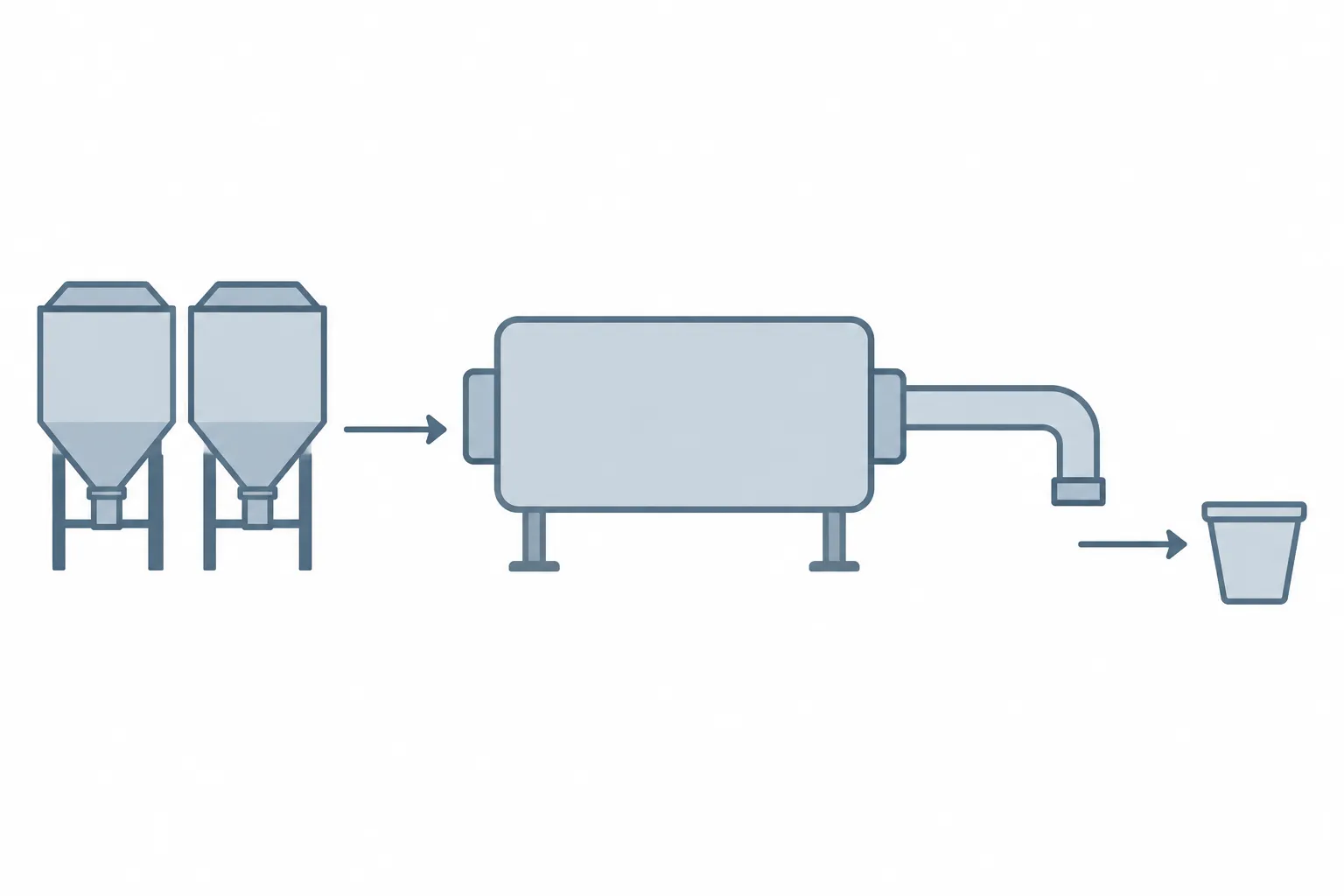
The conceptual map locates three evidence points; it is not a machine drawing or a particle trajectory. Material can have a range of residence times. The width and shape must be investigated for the actual material, configuration and conditions rather than borrowed from an idealized curve or another manufacturer's machine.
Changing shaft speed may also change mixing intensity, heat input or material movement. It is not a substitute for measuring hold-up, flow and discharge composition. An apparent improvement in average blend composition can still conceal short excursions if the sampling plan misses them.
Agree the sampling and disturbance trial
Choose a composition marker or analytical method that can distinguish the relevant components at the required scale. Agree sampling location, frequency, sample mass, analysis and acceptance limits before comparing configurations. A convenient visible tracer is unsuitable if it segregates differently from the critical ingredient or cannot be measured reliably in the actual matrix.
Amixon's technical discussion treats feeding, hold-up, throughput and residence-time investigation as related process variables. The transferable point is the need to qualify the actual process; its equipment settings, features and performance are not MOS specifications.
| Operating state | Evidence to record | Acceptance question |
|---|---|---|
| Stable operation | Actual feed ratios, hold-up, throughput and timed discharge samples | Does the agreed composition variability remain acceptable? |
| A defined feed disturbance | What changed, when it reached the inlet and the discharge response | Can the proposed configuration handle the relevant variability? |
| Start-up or shutdown | Feeding/discharge sequence and separately identified material | Which material is eligible for release? |
| Recipe change | Previous/new material identity, transition samples and carryover result | When can discharge enter the next accepted lot? |
Segregate start-up and changeover material
An established steady-state mean is not a universal waiting period for a new recipe. Feeders, transfer paths and the mixer can retain material, and transitions may not be released by elapsed time alone. Define how start-up and changeover discharge will be identified, sampled and held separately before the campaign begins.
Use the agreed composition and carryover evidence to make release decisions. Do not promise zero off-spec material or select a fixed number of mixer volumes without a supporting investigation. The process must also meet its cleaning and material-handling requirements; a residence-time result does not validate them automatically.
Specify the offered machine and its boundaries
For a continuous-mixer enquiry, provide material identities and variability, particle properties, bulk density, moisture, required feed range, liquid addition and the acceptance method. Ask for the exact agitator, feeding/discharge arrangement, working hold-up basis, relevant options and a representative trial proposal.
Add contact-material, cleaning, integration, utility and destination requirements. Purchase a defined configuration supported by an interpretable trial, not an assumed mixing time calculated from an unqualified catalogue volume.