

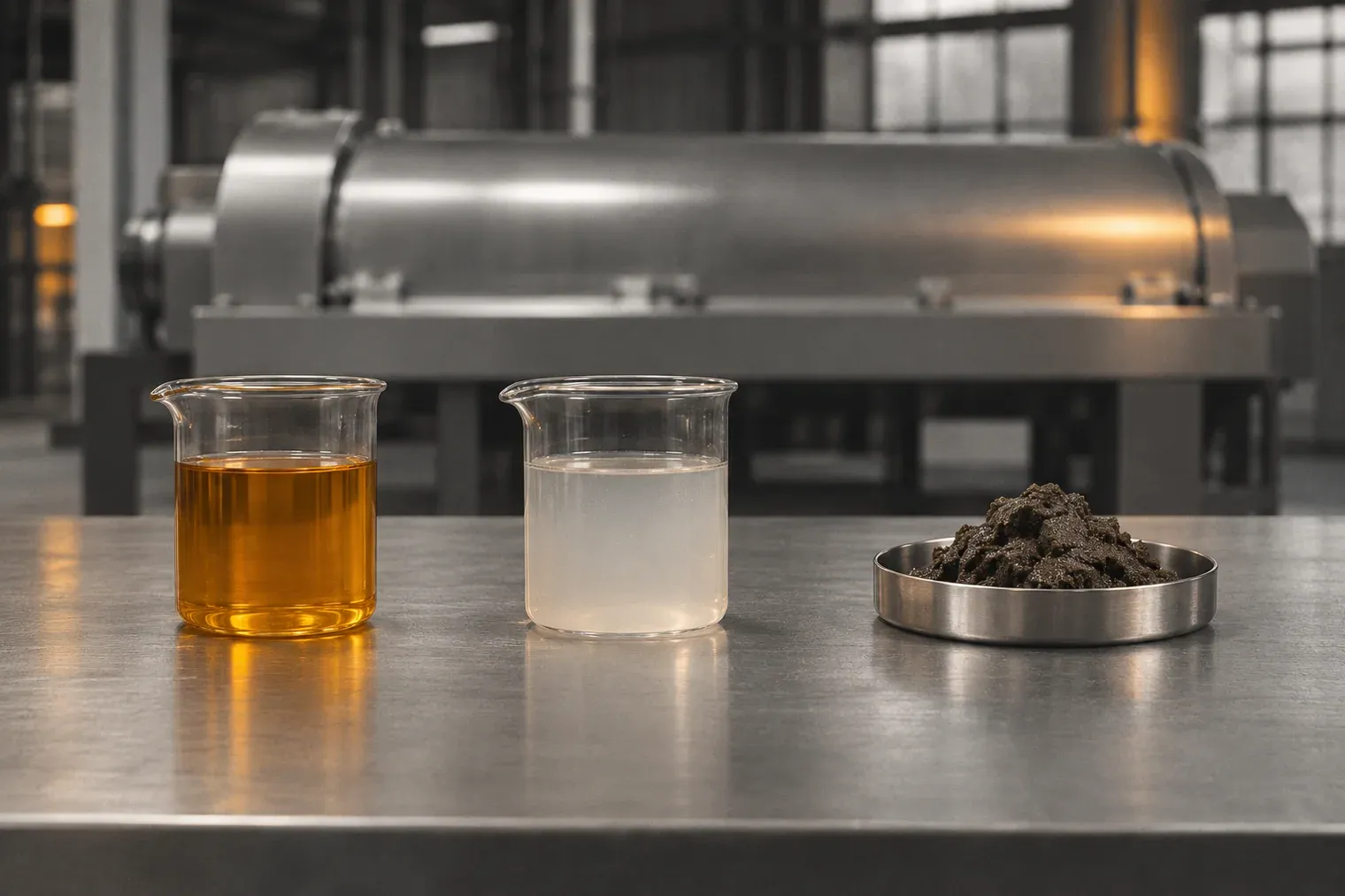
A clean oil sample can come from a trial that loses saleable oil in the water and cake. A dry cake can be produced at a feed rate too low for the planned line. Put the required throughput, the target for each outlet and the method of sampling on the same test sheet before asking suppliers to size a machine.
Decide whether the feed really presents three separable phases
A three-phase decanter uses a rotating bowl and scroll to discharge solids and two liquid streams. In a conventional oil–water–solids duty, the two liquids are immiscible and have enough difference in density to separate under the trial conditions. The settled solids collect at the bowl wall. The denser liquid lies outside the lighter liquid, and the outlets draw from different layers. The outlet arrangement and the way the interface is adjusted depend on the model. Obtain the proposed configuration and specify what the site piping must accept, including whether a liquid is delivered by gravity or under pressure.
Describe the feed at the actual operating temperature: liquid densities, viscosity, range of oil and solids fractions, particle size where it matters, and whether the liquid separates on standing. A bottle that separates after storage says little about freshly pumped feed if the pump shear or upstream surfactants change the dispersion. Bring representative startup, normal and difficult samples, and identify each sample by its useful process conditions. A persistent emulsion calls for testing pretreatment or an alternative process before assuming a larger bowl will solve the problem.
Take the three outlet samples during the same steady run
| Stream | Measure and report | Acceptance question |
|---|---|---|
| Feed | Mass flow and composition, temperature and pretreatment during the sampling window | Is this a representative operating point? |
| Light liquid | Mass flow, recovered oil content, and water or solids on a stated basis | Does it meet the downstream requirement and capture enough of the incoming oil? |
| Heavy liquid | Mass flow, oil and suspended solids using the agreed methods | Can the next treatment step handle the actual carryover? |
| Cake | Wet mass, dry solids and retained oil where it affects the project | Does it meet handling and disposal objectives without unacceptable oil loss? |
Use an agreed stabilization period and sampling window. Record bowl speed, scroll differential, feed rate and the actual interface or outlet settings alongside the results. Account for any conditioning chemical, dilution water, recycle or tank inventory that crosses the test boundary. Close the overall balance first. A large unexplained gap can invalidate a recovery number even when the assay on one bottle looks convincing.
For example, assume a feed of 1,000 kg/h containing 160 kg/h of the target oil. In a hypothetical run, the light liquid is 185 kg/h and contains 148 kg/h of that oil. Oil content in this stream is 80% by mass, while oil recovery to the light stream is 92.5%. Another 12 kg/h of oil must be accounted for elsewhere, subject to measurement uncertainty. These are example calculations, with no implication about a machine’s capability or an acceptable performance limit.
Put the same trial basis in every quotation
Require a single demonstrated operating point that meets the agreed limits simultaneously. Ask what changes at the low and high ends of the feed envelope. If the offer includes feed conditioning, pumping or a polishing separator, include those items in the trial boundary and quotation. Compare a three-phase decanter with a staged process using the same delivered oil quality, water-treatment load and usable operating range.
Send the supplier your flow and load ranges, expected feed temperature, outlet quality limits, sample availability and site pressure constraints. The three-phase decanter catalogue describes configurations to discuss. Use evidence from the actual feed to approve a specific configuration and its performance basis.
Cover illustration of a generic trial bench and representative samples.