

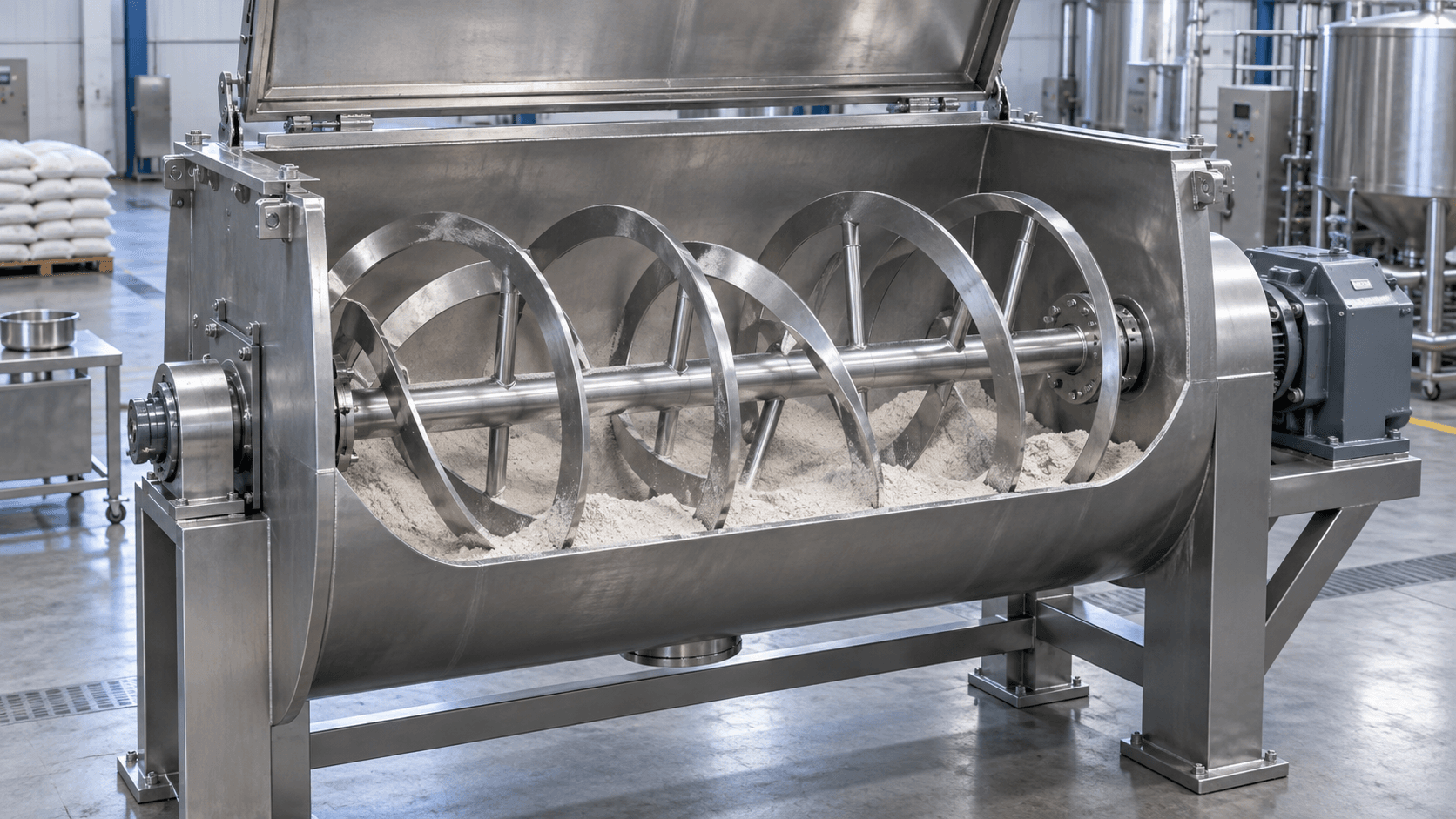
The ribbon blender working principle combines axial movement in opposite directions with radial turnover inside a horizontal trough. Inner and outer helical ribbons circulate the powder through the batch. That explains the mixing action, but it does not establish a cycle time or uniformity guarantee for an unknown material. Equipment selection begins with the batch volume, bulk density, flow behavior and required blend result.
How the ribbon moves material
In the MOS design described on the horizontal ribbon blender page, the outer ribbon transports material toward the center while the inner ribbon returns it toward the ends. Direction depends on ribbon geometry and rotation, so this description should not be generalized to every blender. Confirm the selected machine's arrangement and discharge location in its drawing. Local shear still occurs near the agitator and vessel; the word “ribbon” is not a guarantee of damage-free blending.
Translate batch mass into working volume
Ribbon blender capacity should distinguish the vessel's total volume from the permitted batch working volume. Estimate the required volume from batch mass divided by the representative blend bulk density, using consistent units. State the density measurement basis and expected variation. The supplier then checks the loading range and drive requirements for the actual material.
The MOS size table lists a loading coefficient of 0.4–0.6. As a catalogue calculation, a 1 m³ vessel corresponds to 0.4–0.6 m³ of working volume. This is a sizing reference, not permission to run every powder at either limit. Ask the supplier to confirm minimum and maximum loads, starting torque and permitted batch mass for the offered configuration.
Minor ingredients, liquid addition and sample trials
Specify the lowest-dose ingredient, how it will be introduced and the required acceptance test. Do not use a catalogue component ratio as proof of achievable blend uniformity. Agree sampling locations, sample preparation, analytical method and pass criteria before the trial; include discharge samples if segregation during emptying matters. Confirm whether a pre-blend or revised addition sequence is needed from the trial results.
The listed feed combinations include powder with a small liquid addition. State the proposed amount, addition rate, distribution method and any lumping tendency. Ask the supplier to confirm the limit for that material. High-liquid or paste applications need a separate equipment assessment; they are not automatically covered by the dry-powder description.
Ribbon blender vs paddle mixer
For a comparison, evaluate the actual material on suitable configurations rather than assuming one agitator is always gentler or faster. The twin-shaft paddle mixer is a separate candidate whose loading, discharge and cleaning requirements must be reviewed independently. Provide particle fragility, flow behavior and permitted product damage alongside the uniformity target. Sticky material alone is not sufficient evidence that this paddle model is appropriate.
Specify cleaning and process options
Define residue limits, changeover frequency, access needs and the cleaning method before asking for a configuration. The catalogue lists optional cleaning and temperature/process arrangements; require the quotation to identify exactly what is included. Request the design and validation evidence relevant to your project. A mention of GMP-oriented construction or CIP does not establish certification or validated cleaning performance.
Send a material-based equipment RFQ
- Component identities, representative bulk density, particle characteristics and flow behavior.
- Batch mass, target working volume, minimum/maximum batch sizes and required production schedule.
- Minor-ingredient proportion, addition sequence and any liquid addition.
- Required uniformity, sample plan, acceptable product damage and trial acceptance criteria.
- Cleaning, contact-material, discharge, dust-handling and site-specific design requirements.
- Available utilities, layout, installation destination and required equipment documentation.
Submit this material brief through the horizontal ribbon blender product page. Ask MOS for a proposed configuration, trial plan and quotation, with the sizing assumptions and optional equipment stated separately. Agree the acceptance basis before finalizing the machine, rather than buying on vessel volume or a generic mixing-time claim.
FAQ
What creates mixing in a ribbon blender?
Opposing axial transport and radial turnover circulate the batch. The exact flow direction depends on the ribbon design and rotation.
Is a 1 m³ blender a 1 m³ working batch?
Not necessarily. Total vessel volume and working volume differ. The MOS catalogue coefficient of 0.4–0.6 implies 0.4–0.6 m³ for a 1 m³ vessel, subject to confirmation for the material and configuration.
Can the catalogue component ratio guarantee a uniform blend?
No. Verify the required result through an agreed material trial and sampling method, including discharge behavior where relevant.
Does the optional cleaning package mean the machine is certified?
No. Confirm the supplied design, documentation and project-specific acceptance requirements. A catalogue option is not a certification or cleaning-validation record.