

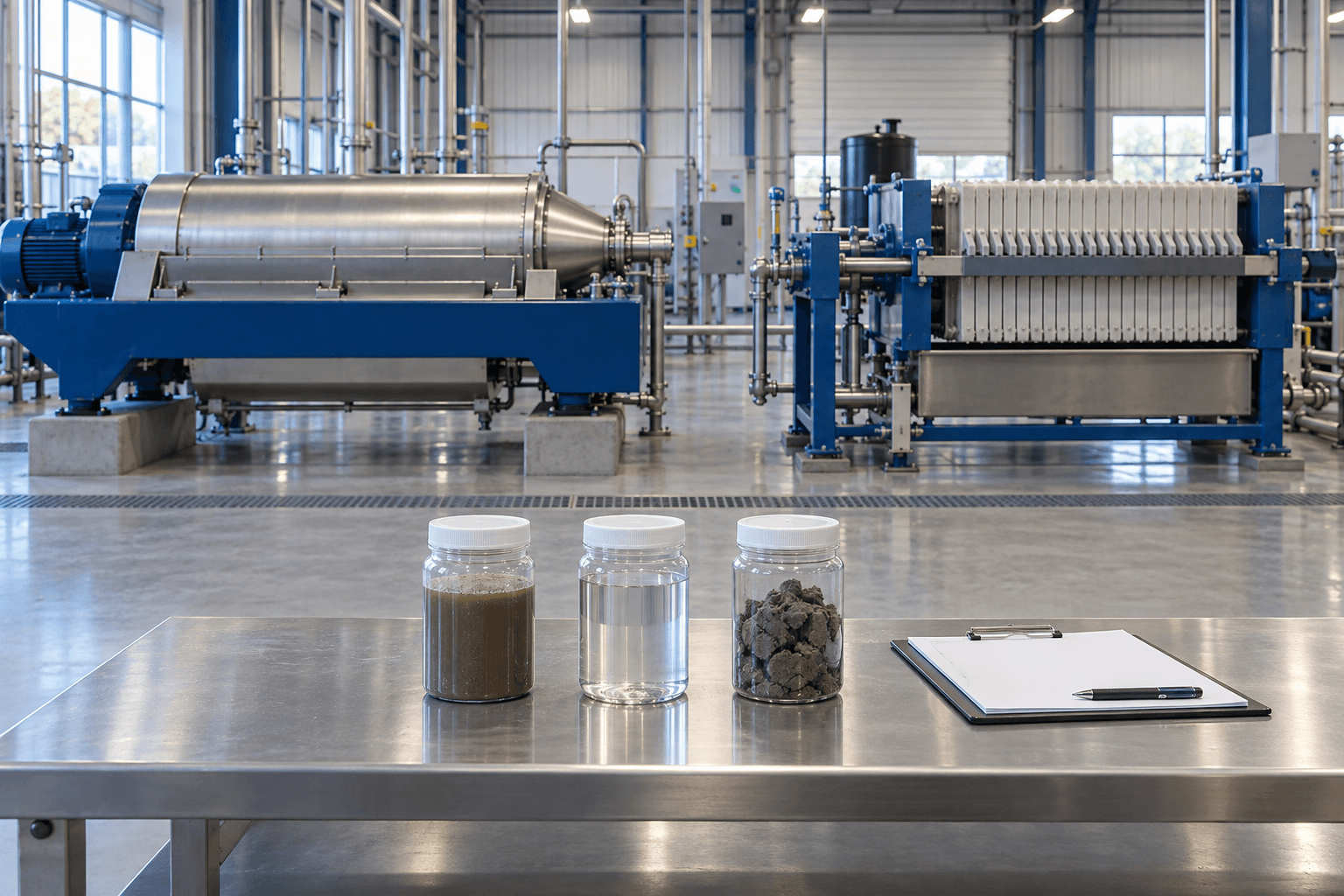
A decanter centrifuge separates by accelerated settling and continuously conveys the separated solids. A recessed-chamber filter press retains solids behind filter cloth and discharges the cake between filtration cycles. For a slurry dewatering project, compare these mechanisms against measured feed behaviour, required liquid clarity, cake handling and the complete operating cycle—not equipment labels alone.
How the two separation mechanisms differ
A decanter centrifuge uses centrifugal force to settle solids in a rotating bowl while a scroll conveys the sedimented solids to the discharge end. Liquid is removed separately, and in the configuration reviewed here, the clarified liquid is discharged through a pressurized centripetal pump. A recessed-chamber filter press is a batch device that pumps slurry into a series of chambers lined with filter cloth; solids accumulate as a cake while liquid passes through the cloth.
A recessed-chamber press cycle includes filling, pressure filtration, depressurisation, opening and cake discharge; washing and cleaning depend on the configuration and duty. Membrane squeezing is a separate design option, not a feature of every recessed-chamber press. A continuous plant can use a batch press with suitable buffering or parallel units, so operating mode alone does not decide the selection.
Key tradeoffs to evaluate
- Compare cake moisture and liquid clarity on the same representative feed. Settling properties matter for a decanter; cake permeability, compressibility and cloth selection matter for a press. Neither technology has a universal guaranteed result.
- Filter presses consume filter cloths and require periodic cloth cleaning, while decanter centrifuges have rotating wear components such as scroll, bearings and seals.
- The linked centripetal-pump decanter has a pressurised liquid outlet. This is a configuration-specific feature, not a property of every decanter; required outlet pressure needs confirmation.
- For a press, evaluate filtration, cake release and cleaning over a complete cycle. Cloth blinding or difficult cake release can reduce effective throughput even when filtration initially looks satisfactory.
Separate feed flow from dry solids loading
A common selection error is to size a decanter centrifuge on volumetric feed flow alone. The dry solids loading, expressed as mass of dry solids per unit time, must be evaluated separately. The centrifuge separates by settling, so particles must settle under the available centrifugal acceleration within the residence time. A slurry with fine or low-density-contrast particles may require a trial to confirm that the scroll can convey the sediment and the centrate clarity meets the target.
Required slurry trial data
Before a selection decision, collect representative slurry samples and run trials under conditions that match the intended duty. The following data should be gathered:
- Particle size distribution, including fine fraction and agglomeration behavior
- Solids loading (mass per volume or mass fraction) and dry solids flow rate
- Liquid viscosity at operating temperature, density contrast, pH and corrosive or abrasive constituents
- Cake dryness target and filtrate clarity requirement
- Washing requirement, if any, and wash liquid compatibility
- Continuous or batch duty cycle, including start/stop frequency and clean-in-place needs
- Temperature and pressure envelope for the feed and separation step
Trial acceptance criteria
Agree acceptance criteria before testing: liquid suspended solids, cake moisture, solids recovery and sustained dry-solids throughput. For a decanter, record discharge stability, torque and vibration against equipment limits. For a press, record the full cycle and cake release, not just pumping time. Also record energy and conditioning-chemical use on the same throughput basis. A short trial can estimate cleaning needs; it cannot establish long-term wear life.
Decision checklist
- Can the plant accommodate a batch cycle, feed buffering and cake discharge? Compare the complete installation with continuous decanter operation.
- Does the feed settle under centrifugal force? If settling is too slow, a decanter centrifuge may require pre-treatment or another method.
- Is cake dryness or filtrate clarity the more important specification? Test both.
- Are there washing steps? Filter press may offer in-situ cake washing; decanter centrifuge washing may need separate equipment.
- What is the dry solids loading? Evaluate mass per hour, not just volume flow.
- What maintenance and staffing can the plant support? Compare rotating-component inspection with cloth care and the proposed manual or automated cake-discharge arrangement.
- What is the available footprint and continuous operation requirement?
Request for quote data
When submitting an inquiry for slurry dewatering equipment, include: material name and composition; capacity basis as both volumetric feed flow and dry solids loading; solids concentration; temperature; target cake moisture; required cleaning method and contact material compatibility; and destination site conditions. This data supports a preliminary technical review before pilot trials.
Use the continuous scroll-discharge decanter catalogue to outline a candidate configuration. Then send the feed and trial requirements to our equipment team. Include available batch size or feed variability, sample availability and destination. Request a documented scope and acceptance basis before comparing quotations.
FAQ
Which machine gives drier cake: decanter centrifuge or filter press?
There is no universal answer. Cake dryness depends on particle size distribution, solids loading, density contrast and applied filtration or centrifugal force. Trials are required to compare the two for a specific slurry.
Can a decanter centrifuge handle a slurry that settles slowly?
A decanter centrifuge relies on settling under centrifugal force. If the solids do not settle sufficiently within the residence time, separation performance may be poor. Bench or pilot settling tests, followed by centrifuge trials, are necessary.
What maintenance should I plan for each technology?
Decanter centrifuges require inspection of scroll, bearings, seals and possibly clean-in-place systems. Filter presses require cloth cleaning and replacement, plate and seal inspection, and cycle-based manual or automated cake discharge.
Do I need pilot trials before choosing?
Representative trials are advisable where comparable operating evidence is insufficient. Agree what laboratory screening can establish and what needs a pilot run. Test cake moisture, liquid clarity, recovery and complete-cycle capacity; short tests do not guarantee long-term operating performance.