

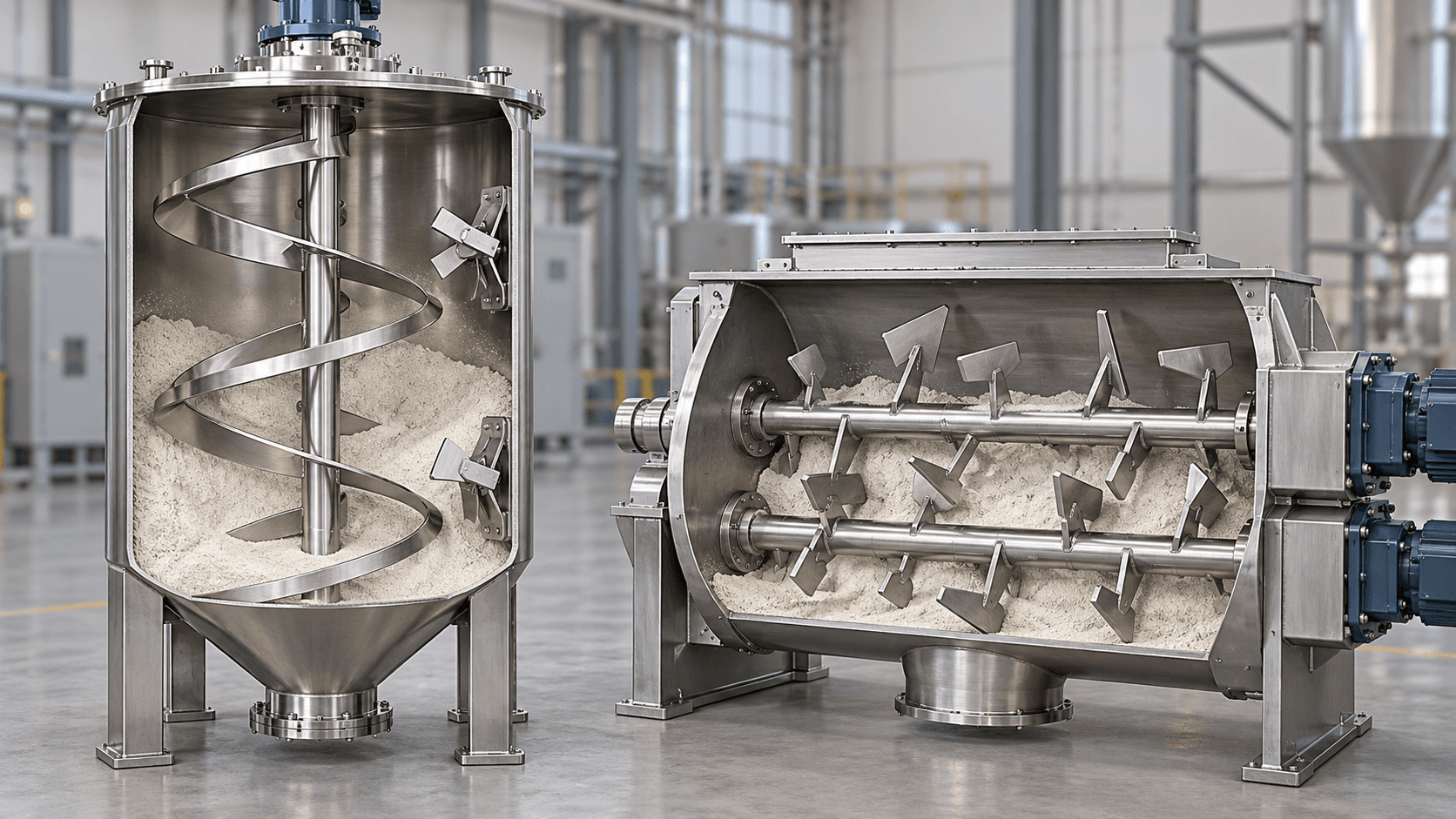
A ribbon mixer is not automatically better or worse than a paddle mixer for an industrial powder batch. First define the actual feed and the acceptance result. Then compare configurations using the same material, batch target and sampling plan. MOS lists a vertical ribbon mixer with side cutters, a horizontal ribbon blender and a twin-shaft paddle mixer; these are distinct equipment routes, not interchangeable model names.
The first comparison is vertical ribbon versus horizontal ribbon
“Ribbon mixer” can mean different vessel geometry. The published MOS vertical ribbon Product is identified with high-speed side cutters, while the published horizontal ribbon Product is a separate machine. Before contrasting either with the paddle option, specify which ribbon configuration is being quoted and whether the proposed cutter package is included. Ask the supplier to show the actual mixing tool, fill range, discharge arrangement and access drawing for the selected model. Catalogue names alone cannot establish its performance with your powder.
Compare the same material and acceptance criteria
The twin-shaft paddle mixer is the separate MOS paddle route. The equipment choice depends on the feed’s particle-size distribution, bulk density, flowability, moisture, cohesion and any liquid addition. None of those properties can be inferred from the mixer name. If agglomerate breakup matters, define how it will be measured and ask whether the proposed configuration includes a suitable tool. Do not accept a general claim of “uniform mixing” without a trial method and agreed result.
| Decision input | Ribbon route | Paddle route | Trial or RFQ evidence |
|---|---|---|---|
| Machine identity | Confirm vertical vessel with cutters or horizontal ribbon trough | Confirm twin-shaft paddle configuration | Ask for the selected model drawing and scope of supplied tooling. |
| Feed behavior | Trial the proposed ribbon configuration with real powder | Trial the proposed paddle configuration with the same powder | Report particle distribution, bulk density, moisture, cohesion and liquid addition. |
| Batch and discharge | Verify working fill and retained material for the offered model | Verify working fill and retained material for the offered model | Agree batch mass, sampling points, residue limit and discharge observation. |
| Changeover | Confirm access and cleaning for the offered configuration | Confirm access and cleaning for the offered configuration | Document cleaning method, contact materials and acceptable carryover. |
Design a useful supplier trial before comparing quotations
Provide a representative sample from the production feed, including minor ingredients and liquid addition where relevant. State the required batch mass, order of addition, proposed sampling points, blend acceptance method and discharge or residual-material limit. Run candidate configurations under comparable conditions and record time, power if measured, sample results, residue and cleanout observations. A result for one trial material and model is not a guarantee for another grade, moisture condition or batch size.
Turn the result into a machine-specific RFQ
Request a quotation only after naming the preferred route: vertical ribbon with cutters, horizontal ribbon blender or twin-shaft paddle mixer. Send the material identity, particle distribution, bulk density, moisture, batch mass, liquid-addition details, contact-material requirement, cleaning/changeover criteria, acceptance test and destination. Ask for a model drawing and written confirmation of working fill, discharge, cleaning access and any offered cutters. Current imported catalogue numeric fields do not establish a reliable model-specific capacity, power, mixing-time or uniformity promise; confirm these against the proposed machine and trial record.
Equipment selection FAQ
Is a ribbon mixer better for every free-flowing powder?
No. Flowability alone does not settle batch fill, mixing acceptance, discharge or cleanout. Compare proposed configurations with a representative material trial.
Does “ribbon mixer” identify one MOS machine?
No. MOS lists separate vertical ribbon with cutters and horizontal ribbon Product pages. Specify the axis, actual tool package and proposed model before comparing it with a paddle mixer.
Can catalogue capacity or uniformity numbers be used in an RFQ?
Do not treat imported catalogue values as a guarantee for a chosen model. Give the supplier your bulk density, batch mass and acceptance method, then request written confirmation and a trial where needed.
What data should an equipment buyer send first?
Send feed identity, particle size, bulk density, moisture, liquid addition, batch mass, contact material, cleaning and discharge requirements, acceptance criteria and destination.