
Food Industry
Milk powder, dairy products, coffee, instant tea, seasonings, proteins and hydrolyzed proteins, soy and peanut proteins, starch, glucose, maltose, pectin and amino acids.
Pressure Spray Drying & Spray Cooling
A continuous pressure-nozzle system for drying, spray cooling and controlled powder or spherical-granule production.
Product Essentials
Select a topic from the directory. The content stays in one focused workspace for faster comparison.
Interactive Equipment View
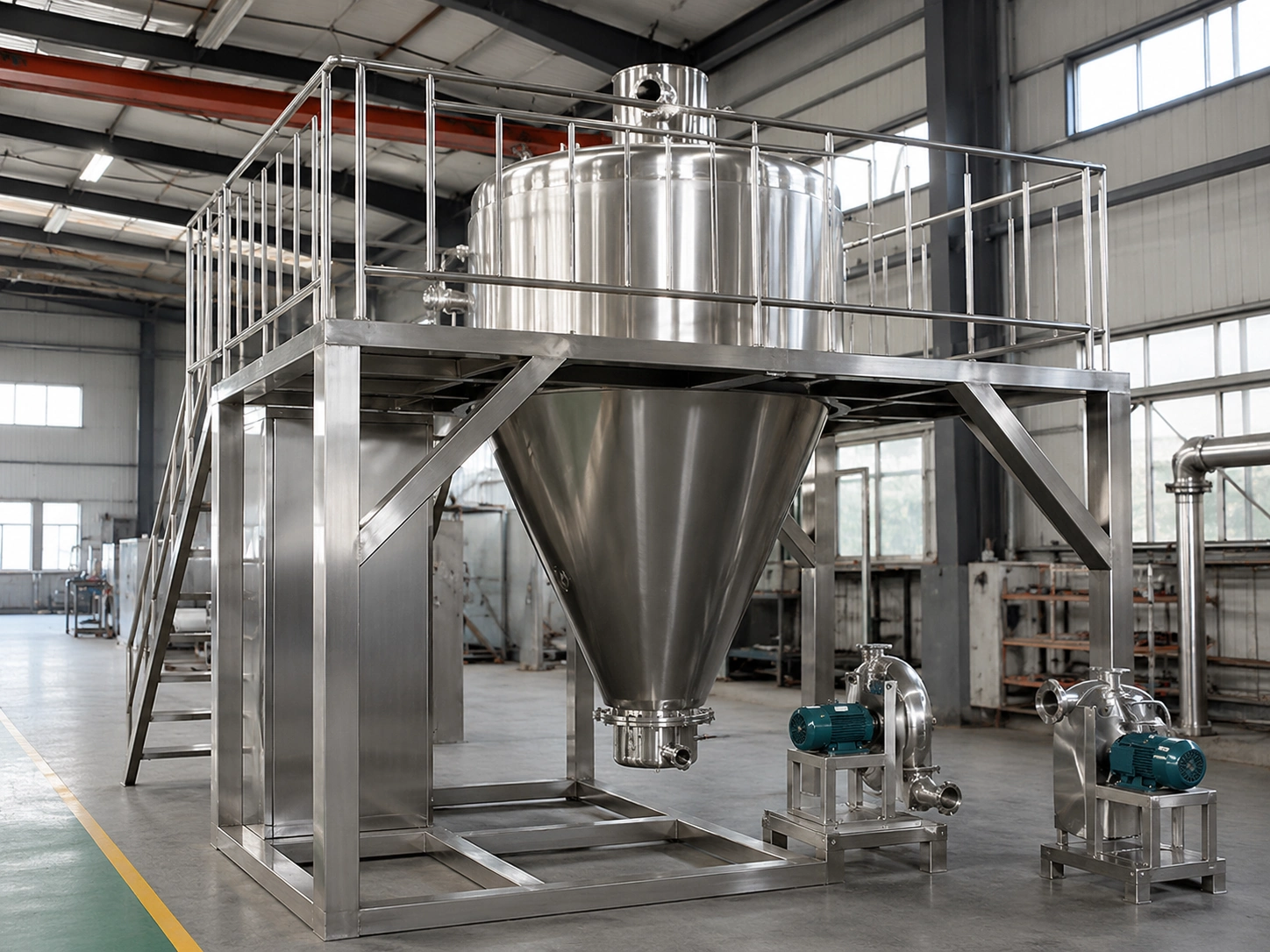
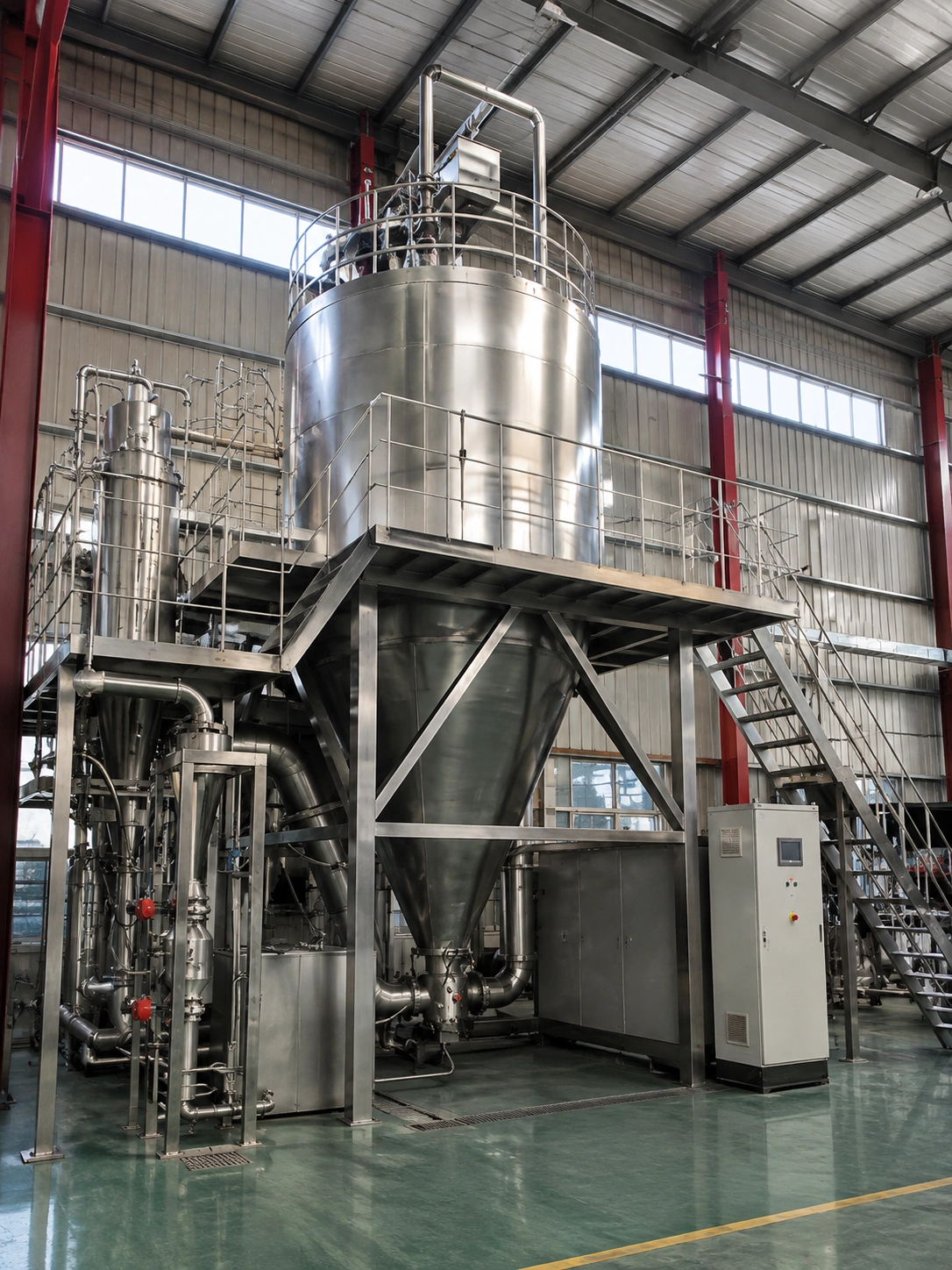
Drag the 3D model to rotate and use the installation photographs for a quick real-world reference.
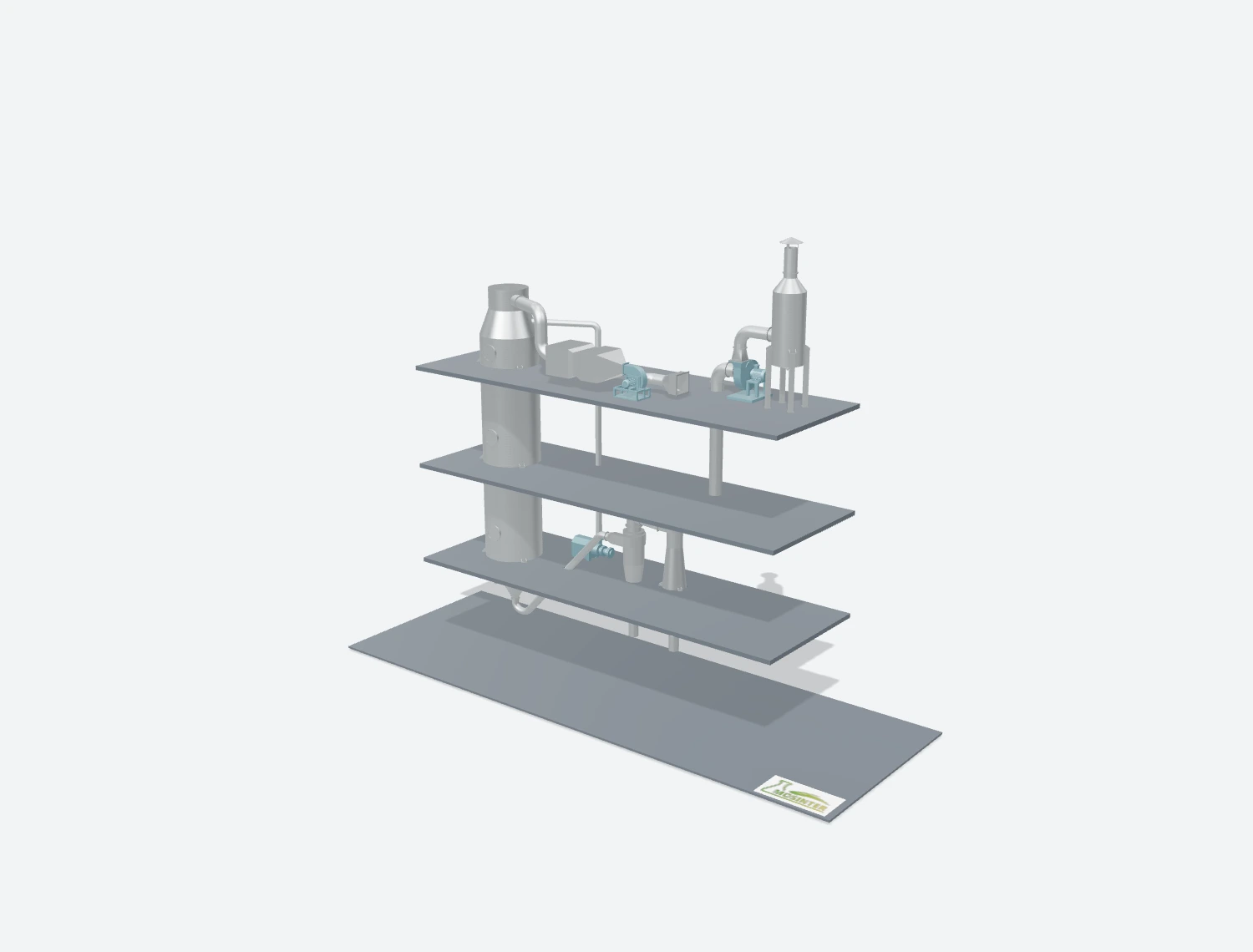
Interactive preview unavailable. Please contact us for equipment details.
Drag to rotate · Scroll or pinch to zoom
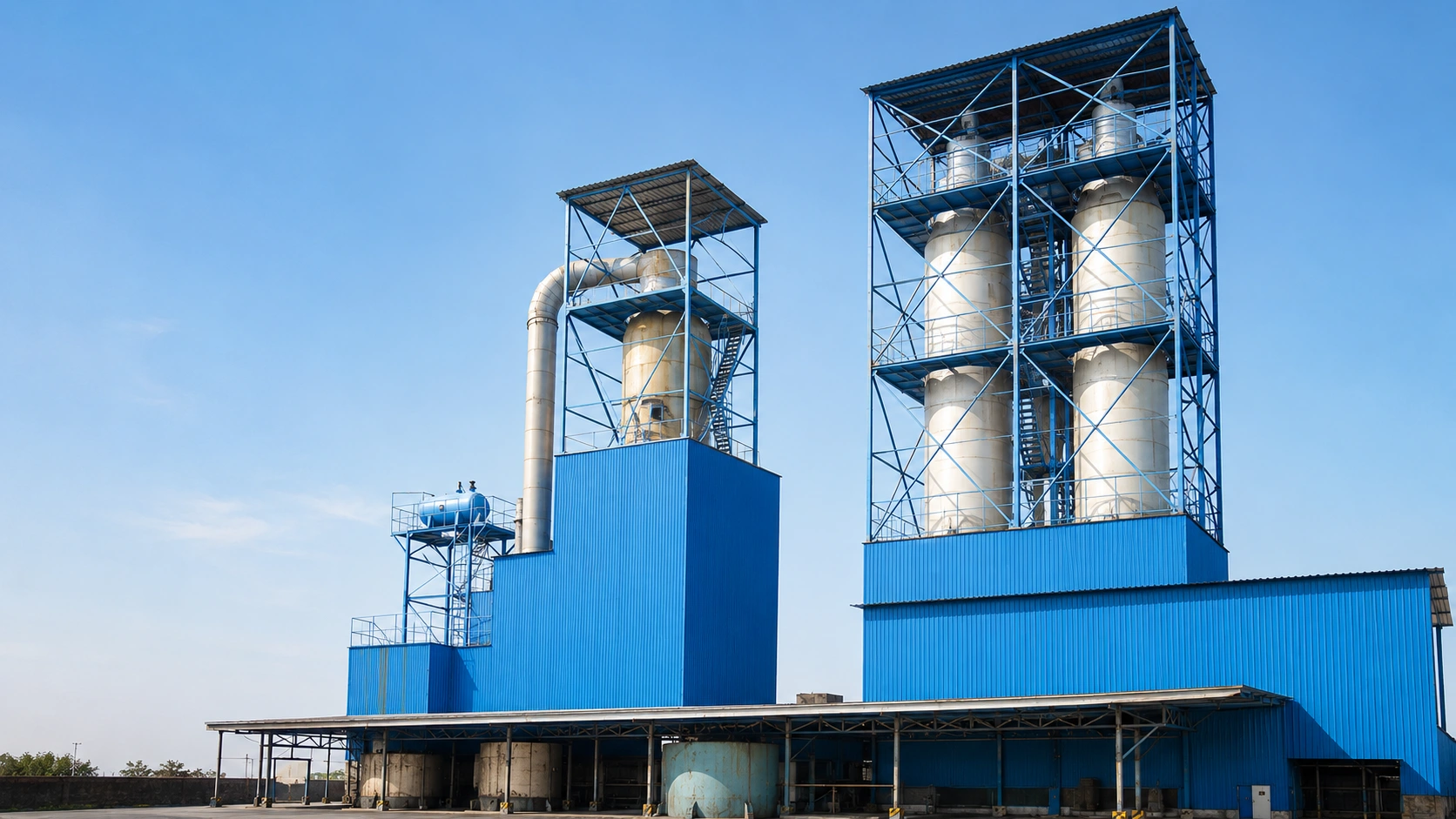
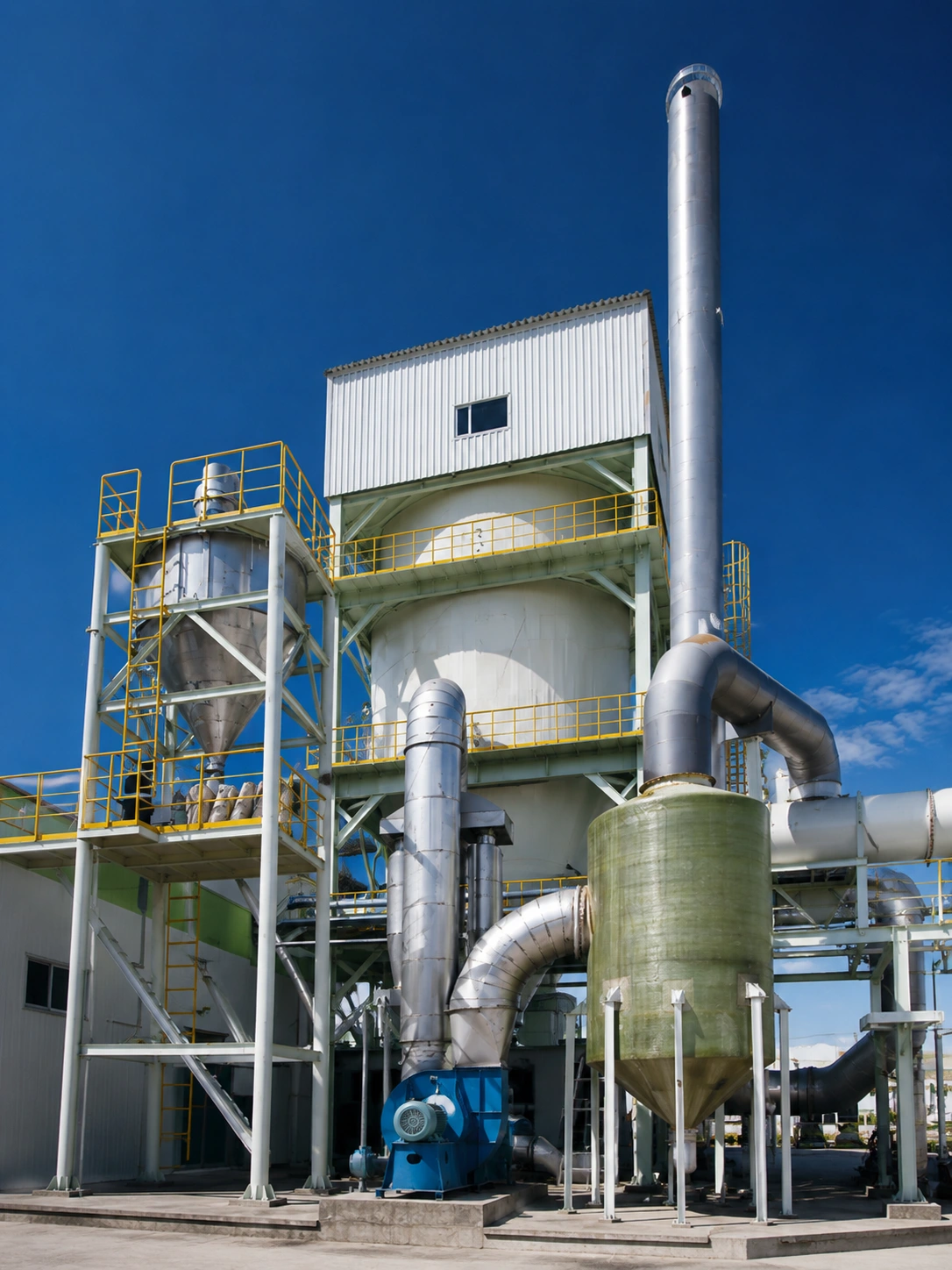
Typical Technical Data
Listed values apply to the identified configuration. Confirm material conditions, utilities and optional equipment before selection.
| Parameter / Size | Unit | 50 | 100 | 150 | 200 | 300 | 500 | 1000 |
|---|---|---|---|---|---|---|---|---|
| Water evaporation | kg | 50 | 100 | 150 | 200 | 300 | 500 | 1000 |
| Overall dimensions (Φ × H) | mm | 1600×8900 | 2000×11500 | 2400×13500 | 2800×14800 | 3200×15400 | 3800×18800 | 4600×22500 |
| High-pressure pump pressure | MPa | 2–10 | ||||||
| Power | kW | 8.5 | 14 | 22 | 24 | 30 | 82 | 30 |
| Inlet air temperature | °C | 140–350 | ||||||
| Product moisture content | % | <5 (down to 0.5) | ||||||
| Material recovery | % | >97 | ||||||
| Electric heating | kW | 75 | 120 | 150 | Below 200°C, determine according to actual technical requirements | |||
| Steam + electric heating | MPa + kW | 0.5 + 54 | 0.6 + 90 | 0.6 + 108 | — | |||
| Hot-air furnace | kcal/h | 100000 | 150000 | 200000 | 300000 | 400000 | 500000 | 1200000 |
The evaporation figures above are maximum values. Note: Evaporation is stated in kg in the supplied data; no time basis is specified. The height of 1880 mm for size 500 and power of 30 kW for size 1000 are retained from the supplied table and require confirmation before selection.
Evaporation figures are reference maximums. Final capacity, equipment dimensions and utilities must be confirmed against the actual material before quotation.
Application Fields
Final suitability should be confirmed through material review and, where necessary, pilot testing.
Milk powder, dairy products, coffee, instant tea, seasonings, proteins and hydrolyzed proteins, soy and peanut proteins, starch, glucose, maltose, pectin and amino acids.
Traditional Chinese medicine extracts, pharmaceutical granules, antibiotics, enzyme preparations, vitamins and other pharmaceutical intermediates.
Catalysts, resins, dyes and dye intermediates, precipitated silica, graphite, ammonium phosphate, chlorides, sulfates and other inorganic salts.
Alumina, magnesia, metal oxides, china clay, ceramic powders, cemented carbides and other functional powder materials.
ABS emulsions, urea-formaldehyde resins, phenolic resins, polyethylene, polyvinyl chloride and other resin materials.
Laundry powder, soap powder, emulsifiers, optical brighteners and other powdered daily chemical products.
Pesticides, fertilizers, ammonium phosphate and other fertilizer or agrochemical formulations.
Process Capabilities
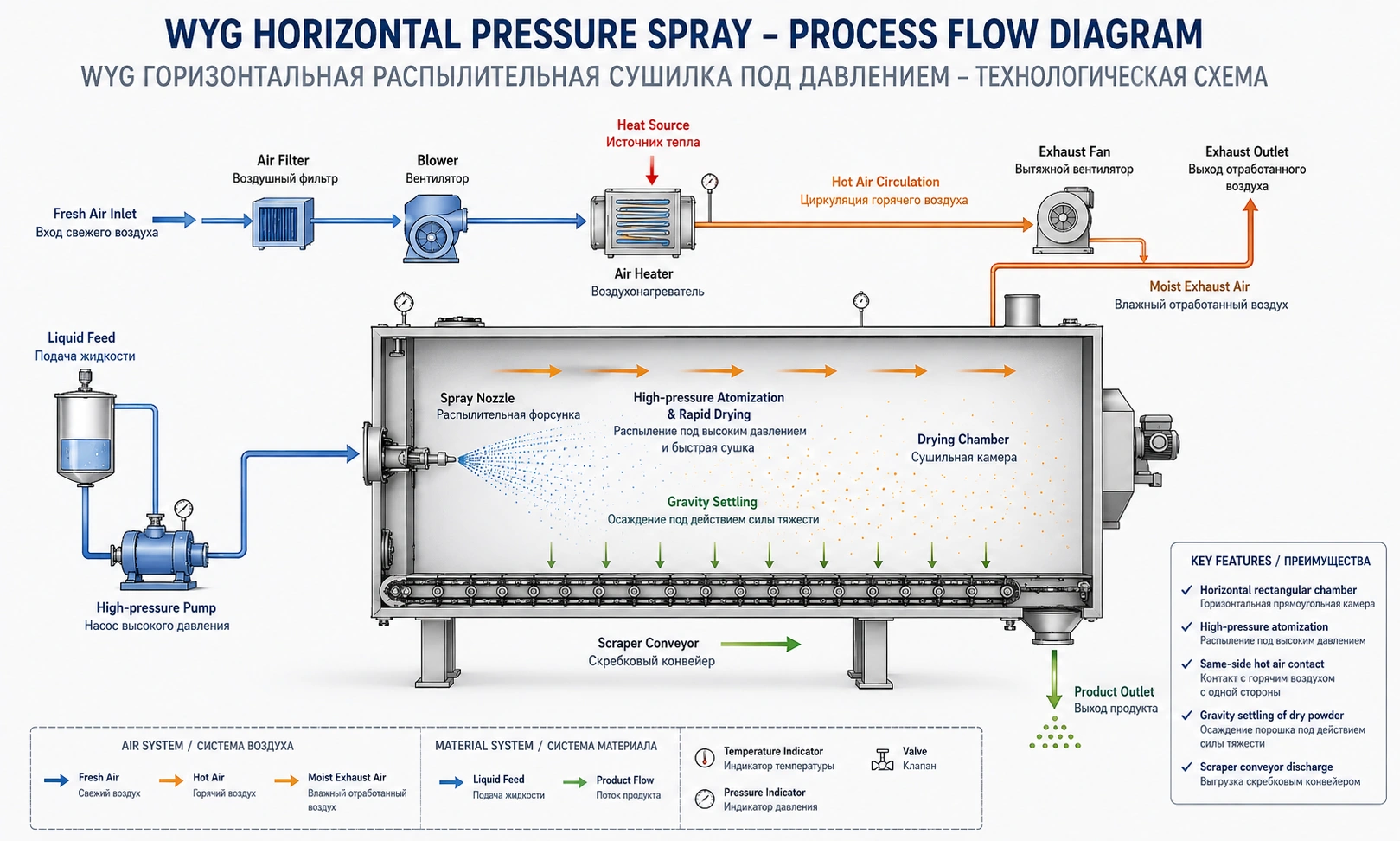
Depending on project requirements, the system can be configured for spray drying, spray granulation, spray-cooling granulation, spray crystallization, spray concentration and spray reaction.
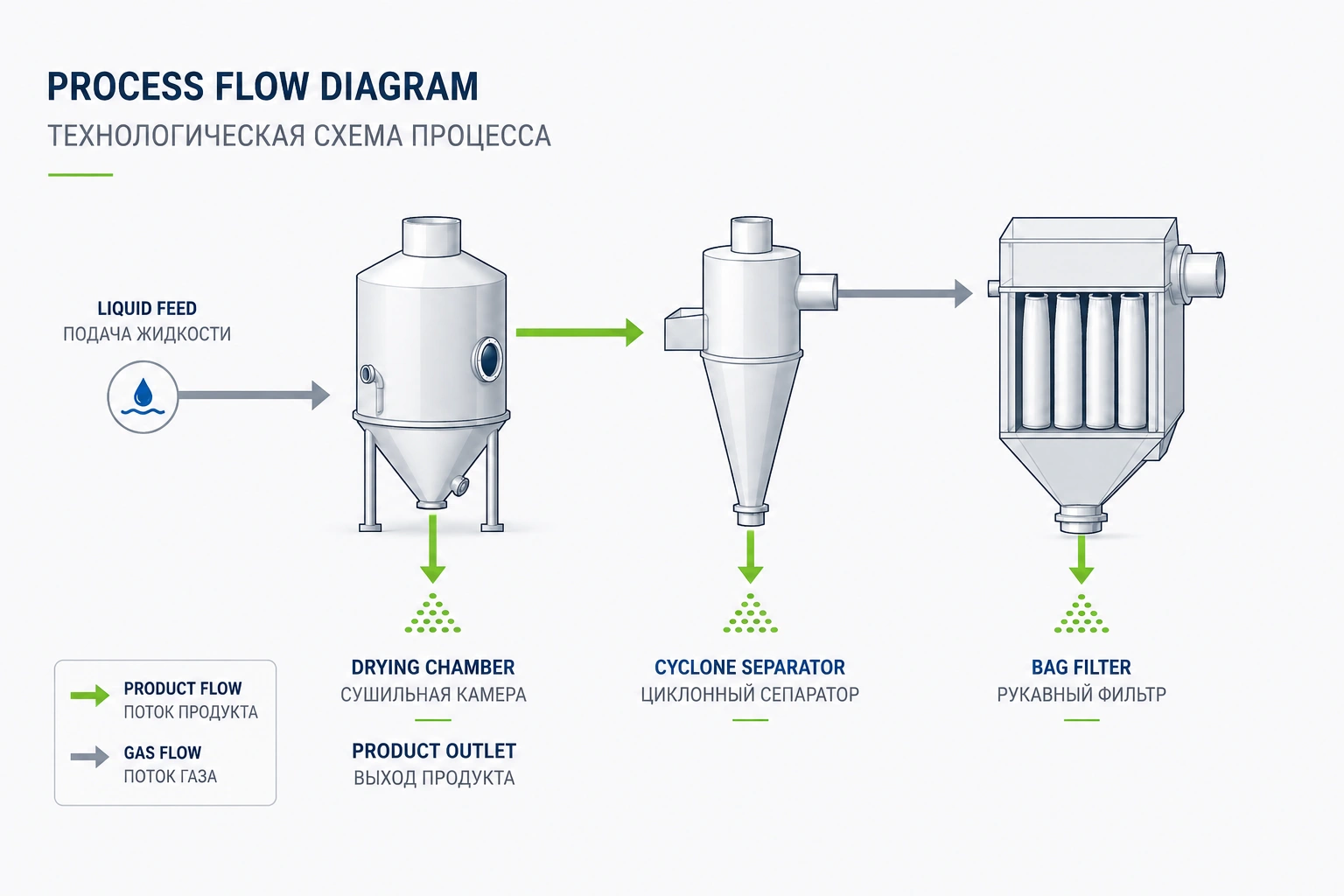
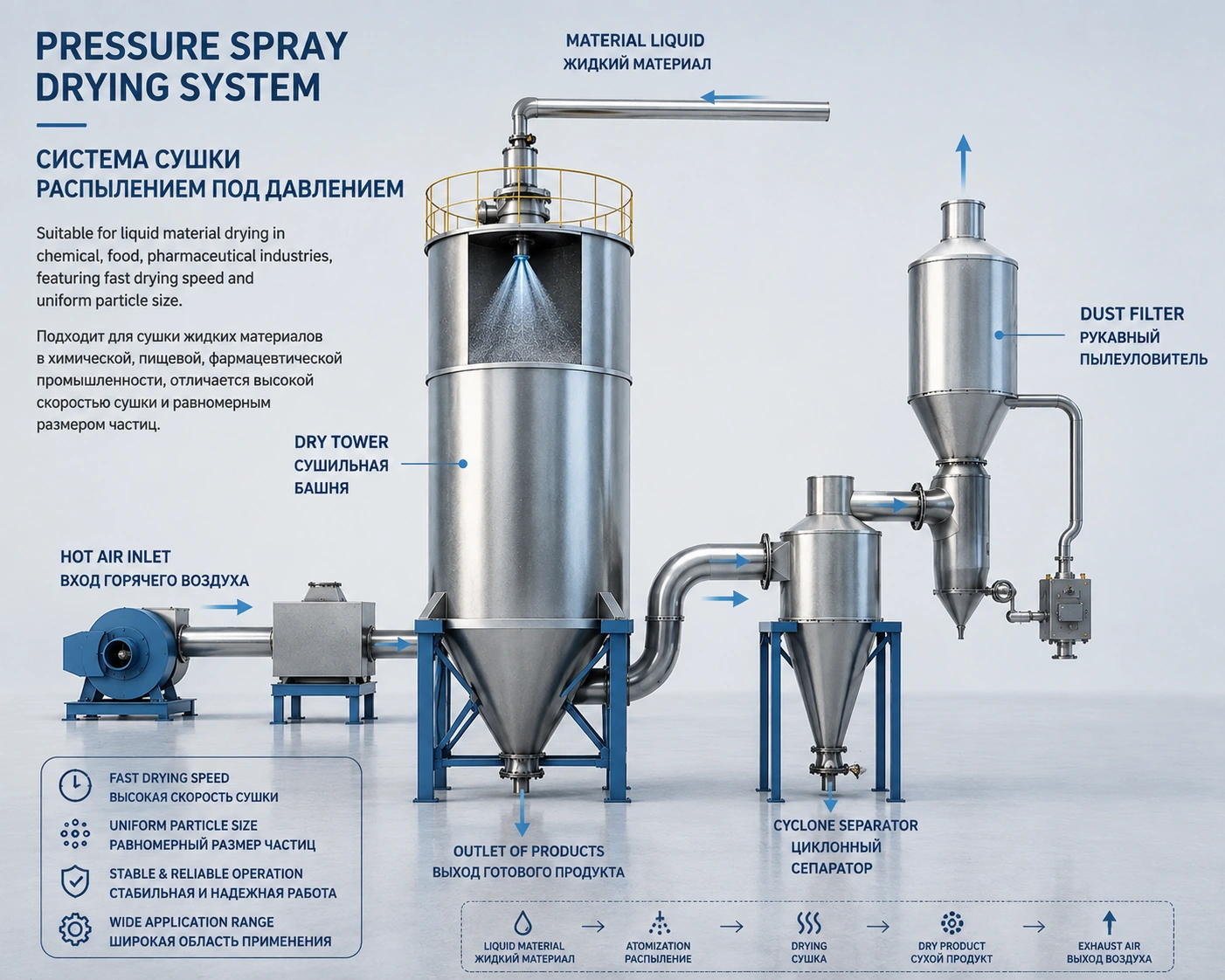
Process Flow Diagram
The final process route and collection scope are configured according to the selected drying, granulation or cooling duty.
Performance Features
Core performance advantages of the pressure-spray system.
Atomization greatly increases the material surface area, enabling rapid drying within tens of seconds and making the process especially suitable for heat-sensitive materials.
The finished particles are uniform, with good flowability and solubility, and high purity.
Depending on the material characteristics, hot-air drying or cold-air granulation can be used for strong process adaptability.
The system offers stable operation and convenient control, making automated production easy to implement.