
Chemical processing
Chemical powders, intermediates and multicomponent formulations.
Industrial Mixers
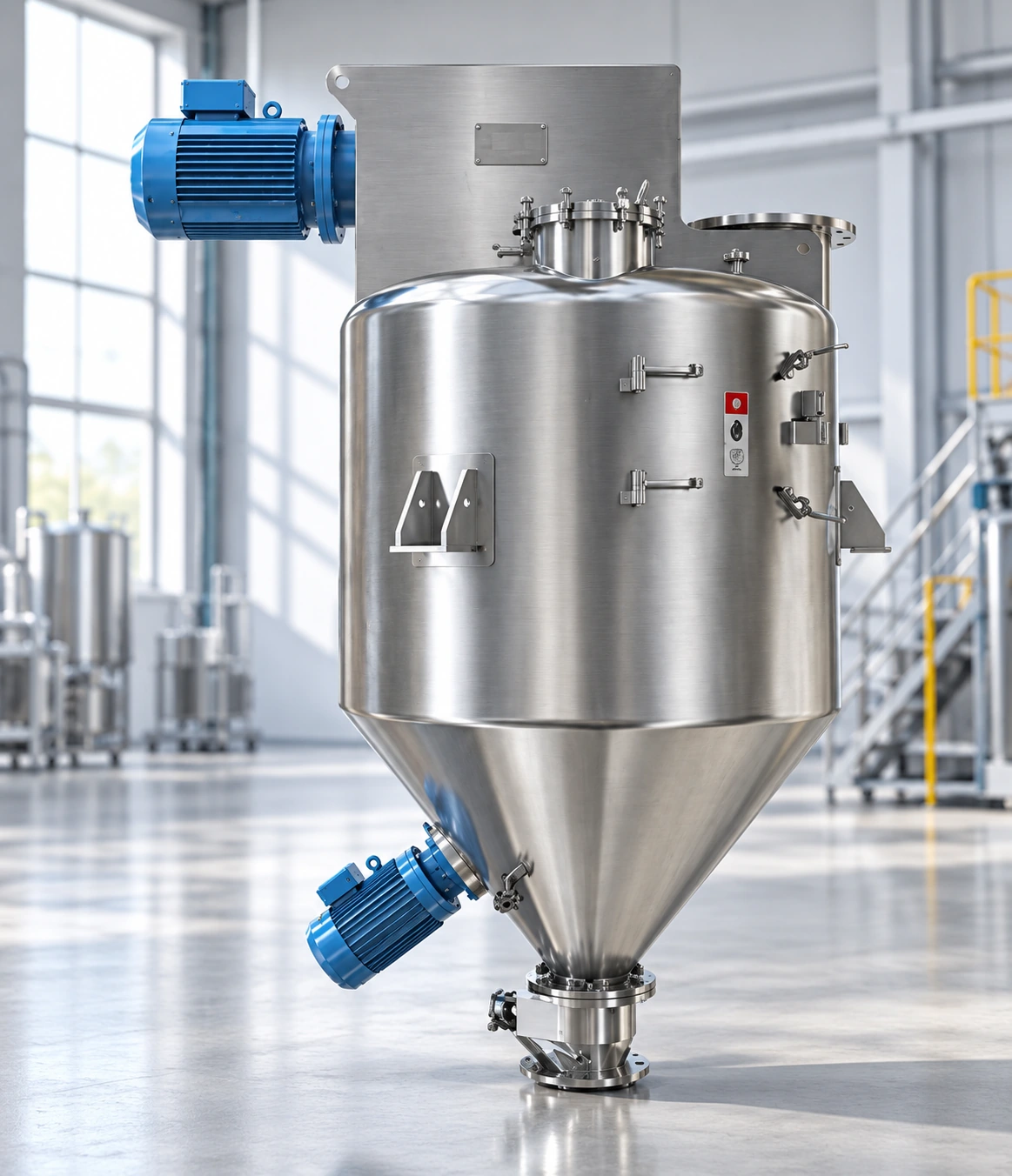
A gentle, energy-efficient batch mixer in which the screw rotates on its own axis while revolving around the centerline of the conical vessel, producing lift, shear, convection and diffusion with low product degradation and minimal discharge residue. Designed and manufactured for chemical processing and dyes and pigments. Review the working principle, performance features and available configuration details below when specifying your industrial project.
Product Essentials
Select a topic from the directory. The content stays in one focused workspace for faster comparison.
Interactive 3D Preview
Exterior preview of the pictured configuration. Rotate the model and inspect its visible components. Final dimensions and fitted options are confirmed for your project.
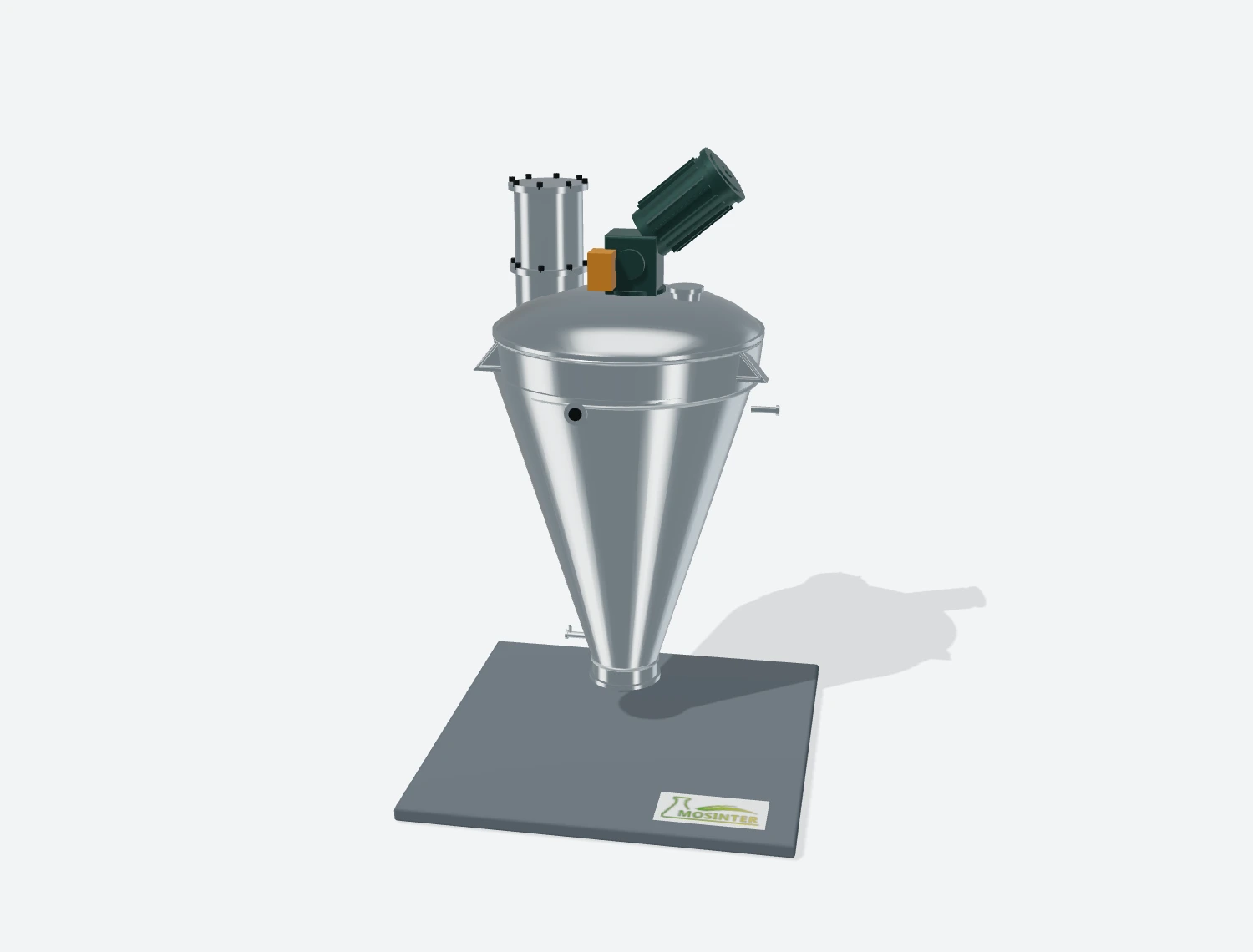
Load the preview to rotate, zoom and inspect the model.
Product Overview
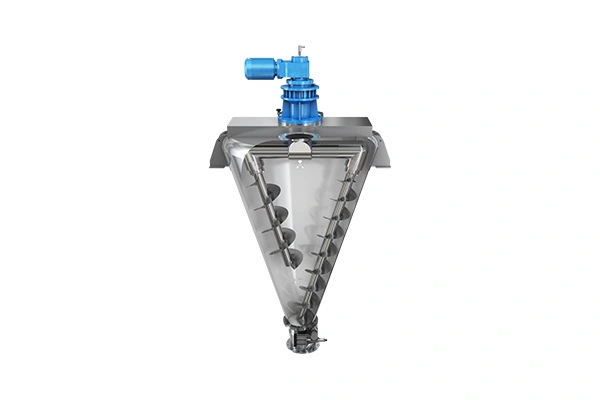
The mixer uses a single long screw, an asymmetric twin-screw arrangement or a three-screw arrangement inside a conical vessel, depending on equipment size. The screw rotates about its own axis while revolving around the vessel centerline, continuously lifting and circulating the batch.
This compound motion generates shear, convection and diffusion for uniform blending with low energy demand, limited particle degradation and minimal residual hold-up. It is well suited to powder + powder, granule + powder and powder + a small liquid addition, including coarse, fine, fibrous and flake-like materials.
Typical applications include chemicals, dyes, pigments, agrochemicals, veterinary products, pharmaceuticals, plastics and additives. Heating, cooling, liquid spraying, pressure/vacuum, CIP and pull-out versions are available.
Typical Technical Data
Listed values apply to the identified configuration. Confirm material conditions, utilities and optional equipment before selection.
| Parameter | Reference value |
|---|---|
| Equipment type | Conical screw batch mixer |
| Series total-volume range | 0.06–30 m³ |
| Loading coefficient | 0.4–0.6 |
| Series motor-power range | 1.5–45 kW |
| Available screw arrangements | Single screw / twin screw / three screws |
| Twin-screw arrangement | One long screw and one short asymmetric screw, subject to mixer size |
| Suitable feed combinations | Powder + powder / granule + powder / powder + a small amount of liquid |
| Heating or cooling media | Industrial water for cooling / steam or thermal oil for heating |
| Feeding methods | Manual charging / vacuum conveying / conveyor feeding |
| Standard outlet concept | Close-fitting lobed offset valve; manual or pneumatic actuation |
| Optional process functions | Liquid spraying / heating / cooling / positive pressure / vacuum / CIP / pull-out construction |
Final equipment dimensions, utilities and performance must be confirmed before quotation.
Technical Specifications
Seventeen models from 0.06 to 30 m³ are listed for preliminary comparison. Final dimensions, power and weight remain subject to material properties and engineered options.
| Reference Model | Total Volume (m³) | Loading Coefficient | Motor Power (kW) | Maximum Diameter × Height (mm) | Weight (kg) |
|---|---|---|---|---|---|
| DSH-0.06 | 0.06 | 0.4–0.6 | 1.5 | Φ630 × 1451 | 150 |
| DSH-0.1 | 0.1 | 0.4–0.6 | 1.5 | Φ715 × 1569 | 250 |
| DSH-0.3 | 0.3 | 0.4–0.6 | 2.2 | Φ920 × 1960 | 550 |
| DSH-0.5 | 0.5 | 0.4–0.6 | 3 | Φ1140 × 2320 | 600 |
| DSH-1 | 1 | 0.4–0.6 | 4 | Φ1480 × 2895 | 1200 |
| DSH-1.5 | 1.5 | 0.4–0.6 | 5.5 | Φ1633 × 3210 | 1350 |
| DSH-2 | 2 | 0.4–0.6 | 5.5 | Φ1816 × 3495 | 1500 |
| DSH-3 | 3 | 0.4–0.6 | 7.5 | Φ2040 × 3760 | 2300 |
| DSH-4 | 4 | 0.4–0.6 | 11 | Φ2250 × 4425 | 2520 |
| DSH-6 | 6 | 0.4–0.6 | 15 | Φ2548 × 4940 | 3000 |
| DSH-8 | 8 | 0.4–0.6 | 18.5 | Φ2780 × 5360 | 4500 |
| DSH-10 | 10 | 0.4–0.6 | 22 | Φ3018 × 5815 | 5500 |
| DSH-12 | 12 | 0.4–0.6 | 22 | Φ3204 × 6100 | 5900 |
| DSH-15 | 15 | 0.4–0.6 | 30 | Φ3442 × 6540 | 6600 |
| DSH-20 | 20 | 0.4–0.6 | 37 | Φ3805 × 7420 | 9800 |
| DSH-25 | 25 | 0.4–0.6 | 37 | Φ4086 × 7800 | 10200 |
| DSH-30 | 30 | 0.4–0.6 | 45 | Φ4330 × 8200 | 11500 |
The loading coefficient, motor power, dimensions and weight are reference values. Confirm the final design after material review and process-option selection.
Applications
Applications include chemical processing and dyes and pigments. Confirm material properties and process conditions before selecting the equipment configuration.
Chemical powders, intermediates and multicomponent formulations.
Coarse/fine blends and colorant formulations requiring gentle, uniform distribution.
Pesticide powders and related formulated products.
Veterinary pharmaceutical powders and premixes.
Pharmaceutical powders, intermediates and heat-sensitive formulations.
Polymer additives, processing aids and related powder or granule blends.
Working Principle
The process route is selected around the material and product targets.
Powder, granules or powder with a small liquid addition is introduced manually, by vacuum conveying or by mechanical conveyor.
The screw rotates about its own axis and conveys product upward along the flight.
At the same time, the screw revolves around the central axis of the conical vessel and sweeps a broad mixing path.
The combined motion repeatedly lifts, folds and recirculates the batch from the lower cone through the working volume.
Overlapping flow patterns distribute coarse and fine fractions, major ingredients and low-dose components throughout the batch.
After the required uniformity is reached, the cone directs the product to the selected close-fitting bottom outlet.
Performance Highlights
Final performance remains dependent on feed properties and engineering confirmation.
Screw self-rotation and planetary revolution combine to create multi-directional circulation throughout the cone.
Suitable combinations include powder + powder, granule + powder and powder + a small amount of liquid.
Efficient lifting and circulation provide uniform blending at relatively low operating power.
The low-impact mixing action helps preserve granular integrity and limits unnecessary particle breakage.
The mixer accommodates coarse/fine blends, multicomponent formulations, large component-ratio differences and heat-sensitive materials.
Gentle circulation reduces frictional heating and helps protect heat-sensitive products from local overheating.
The conical geometry and close-fitting outlet arrangement help reduce retained material after discharge.
Heating, cooling, positive-pressure and vacuum designs can be engineered for project-specific duties.
CIP circulation and internal spraying can clean the vessel without routine manual dismantling.
System Configuration
Select options for the material and process. Availability and final scope are confirmed in the equipment specification.
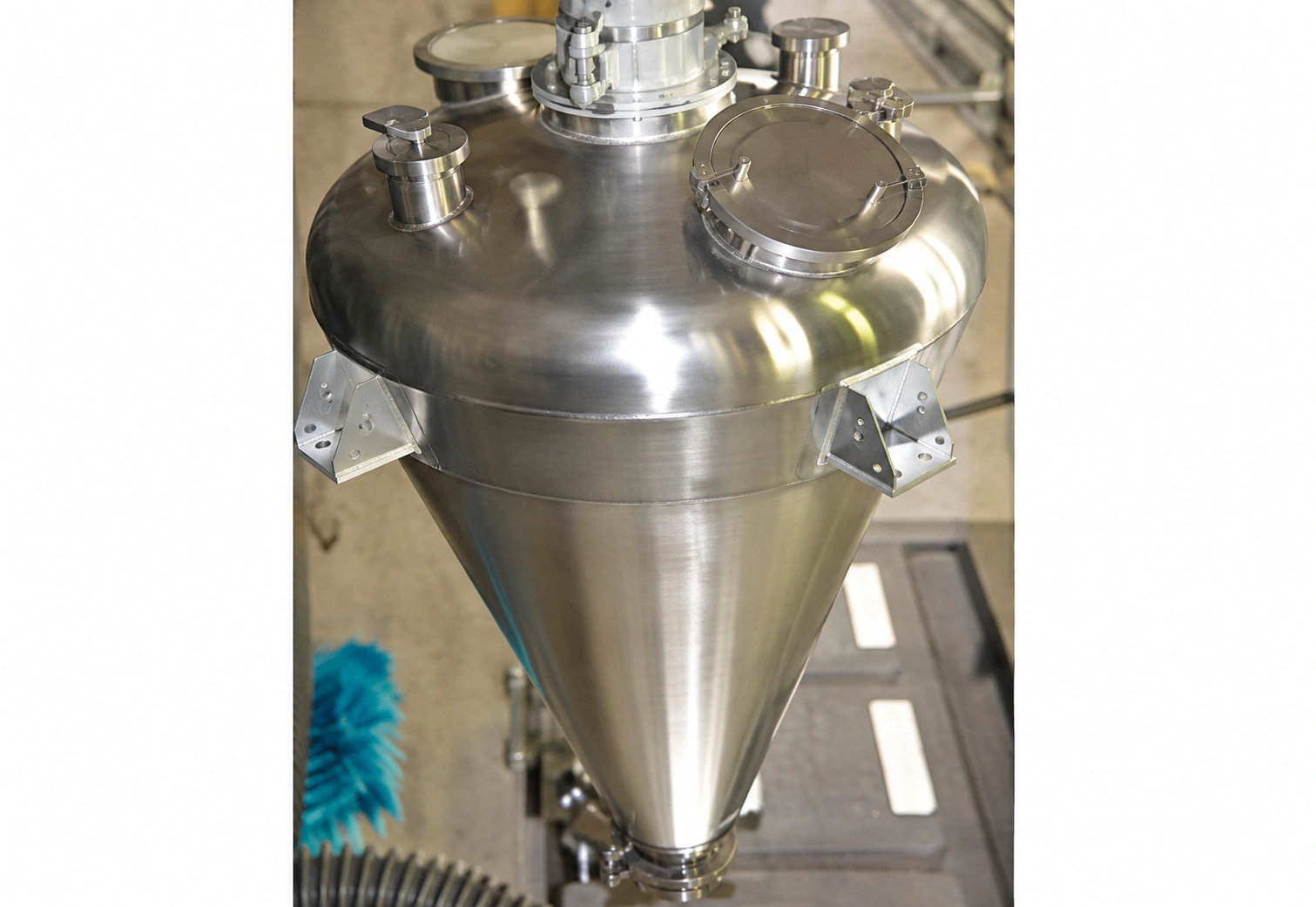
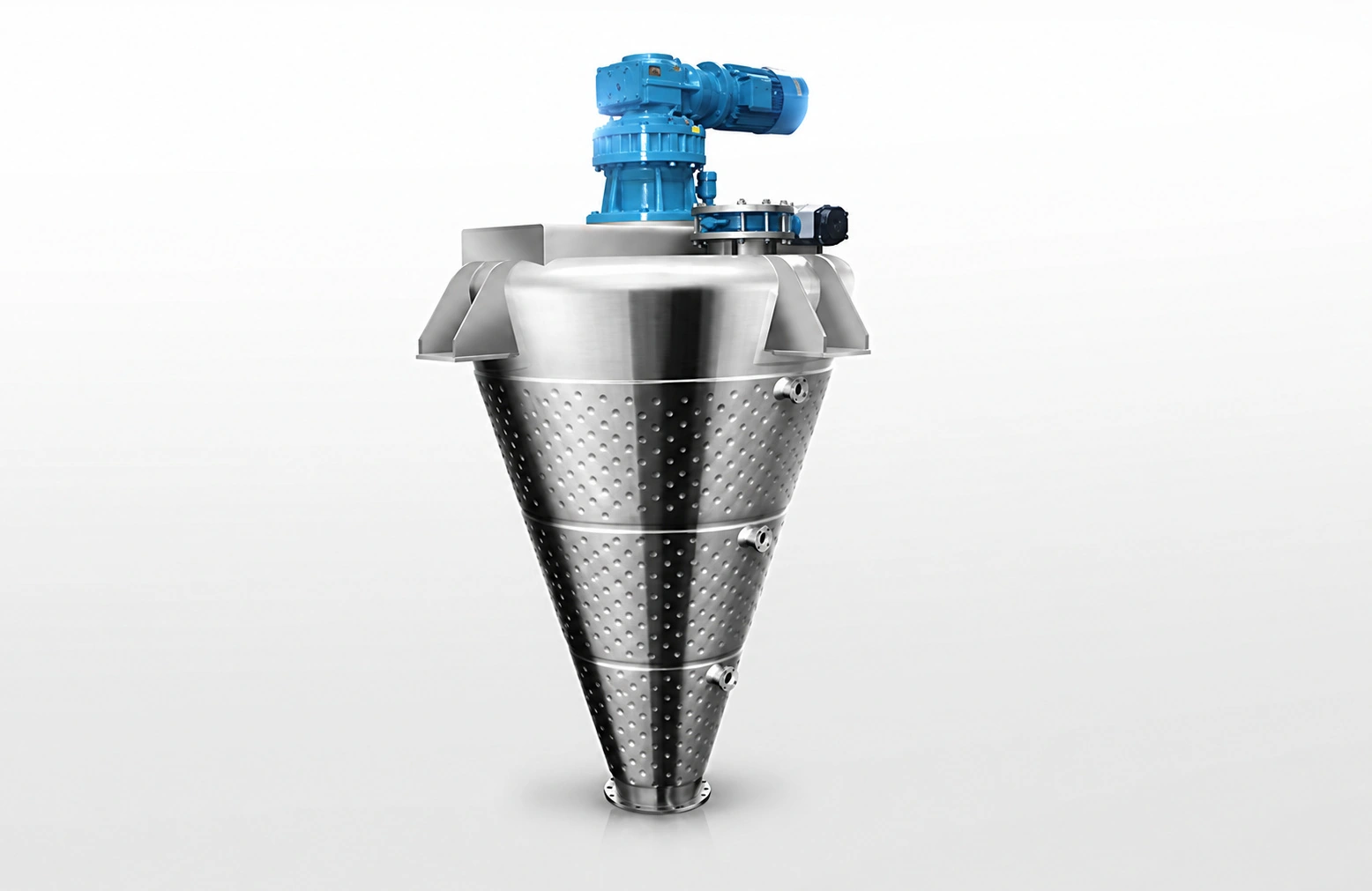
The smooth cone promotes complete circulation and directs the finished product toward a low-residue bottom outlet.
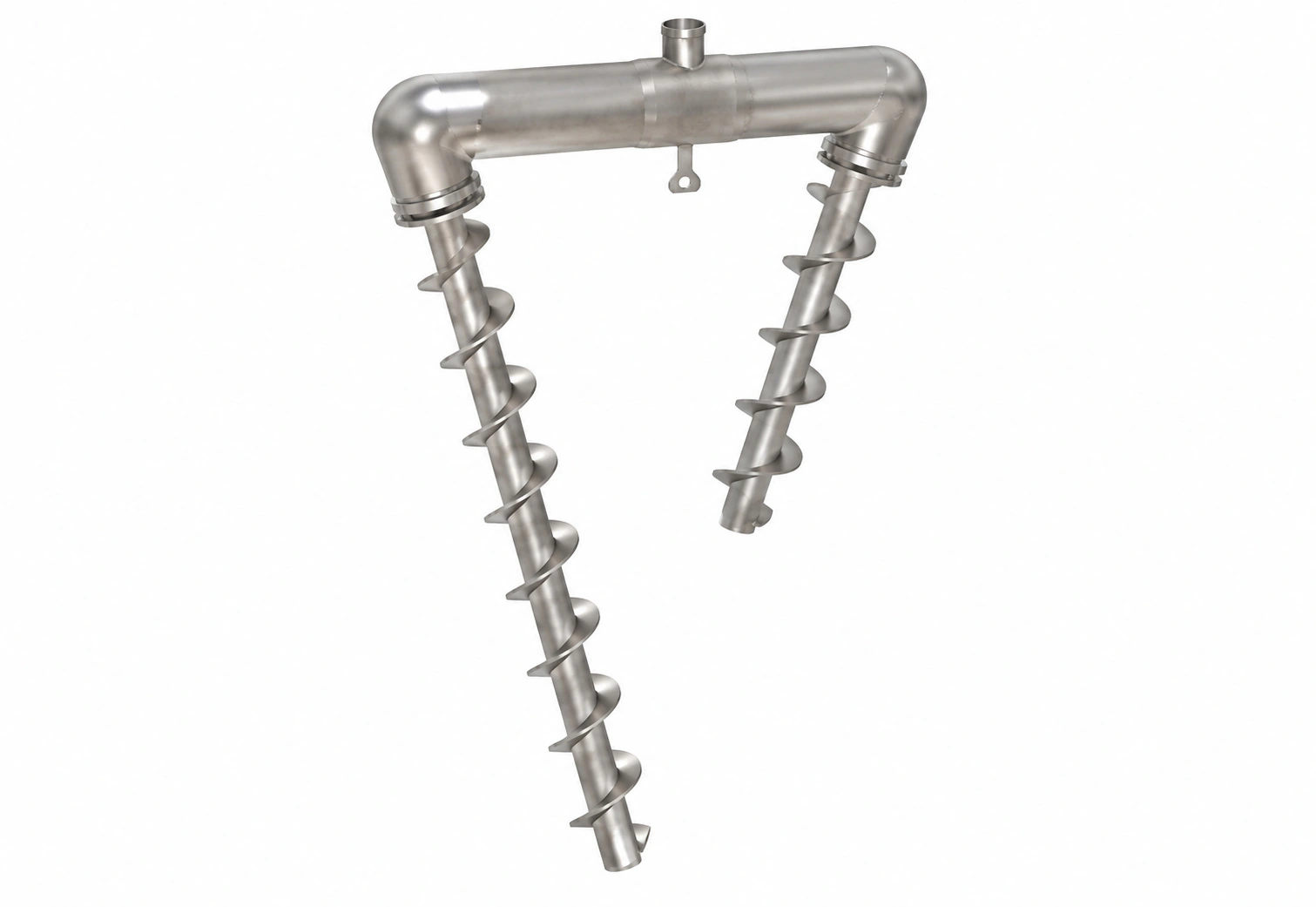
A long planetary screw provides gentle lifting and circulation for the selected vessel size.
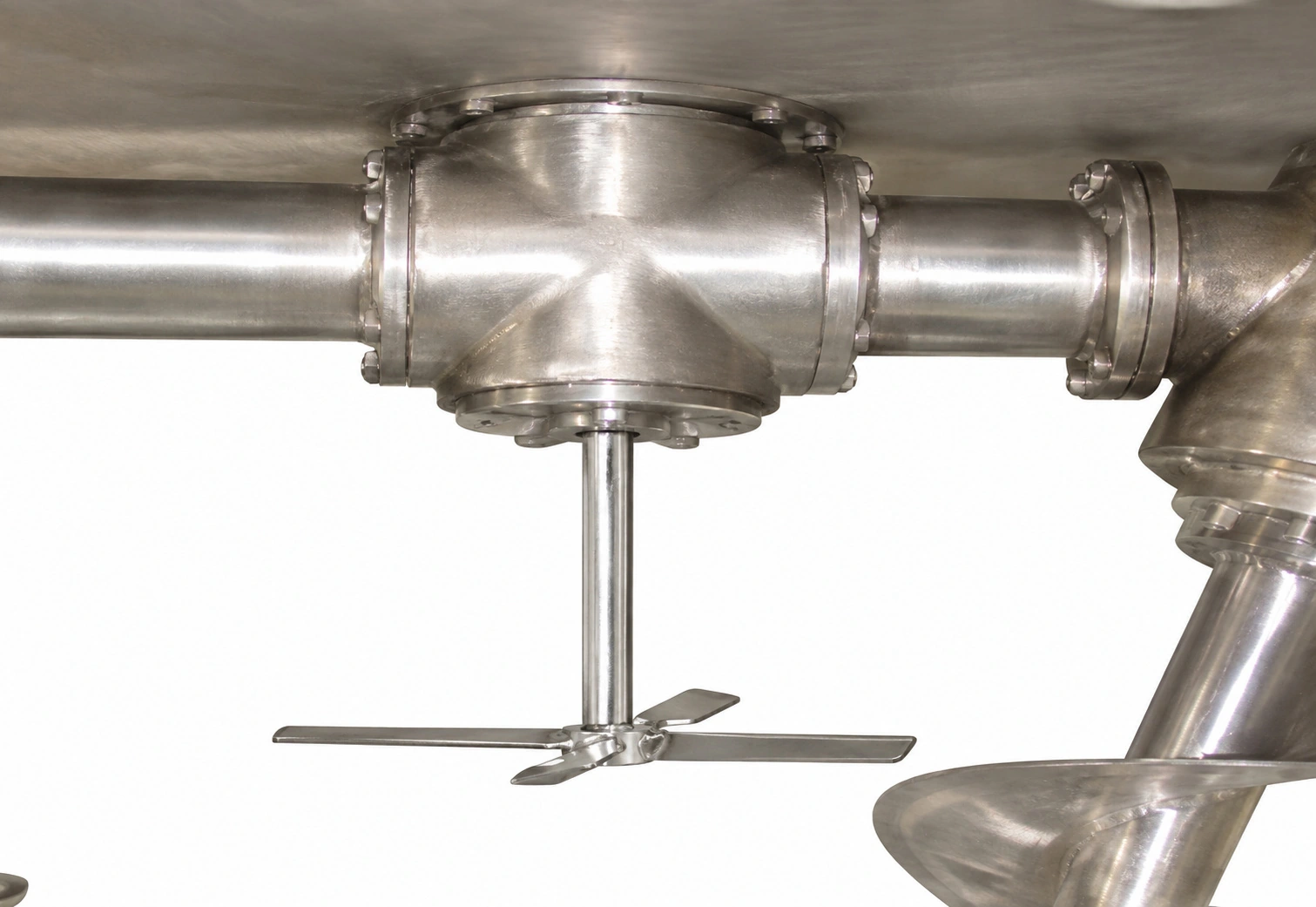
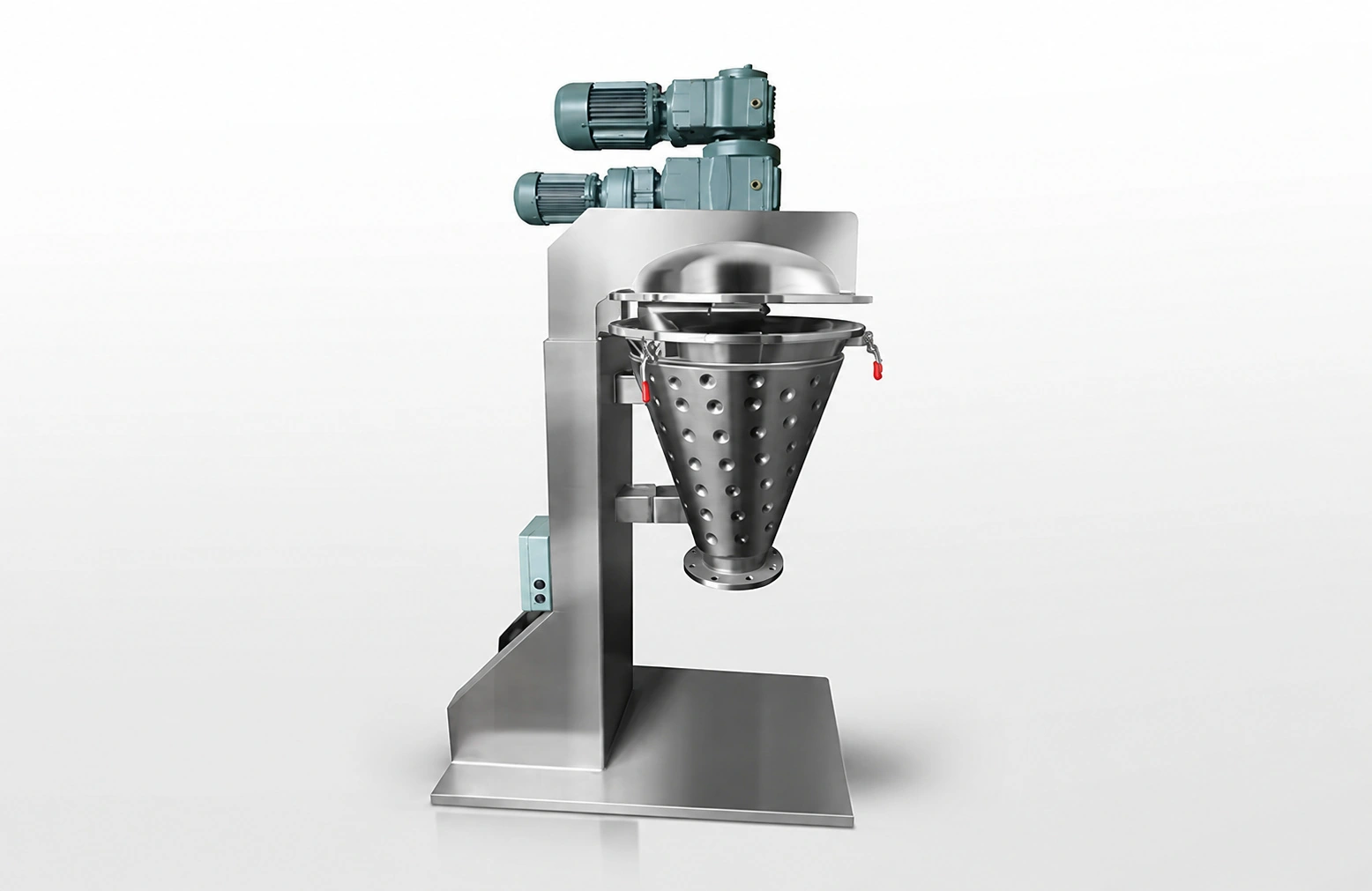
One long and one short asymmetric screw form the twin-screw arrangement. A three-screw option uses two short screws and one long screw in a symmetric layout, depending on equipment size.
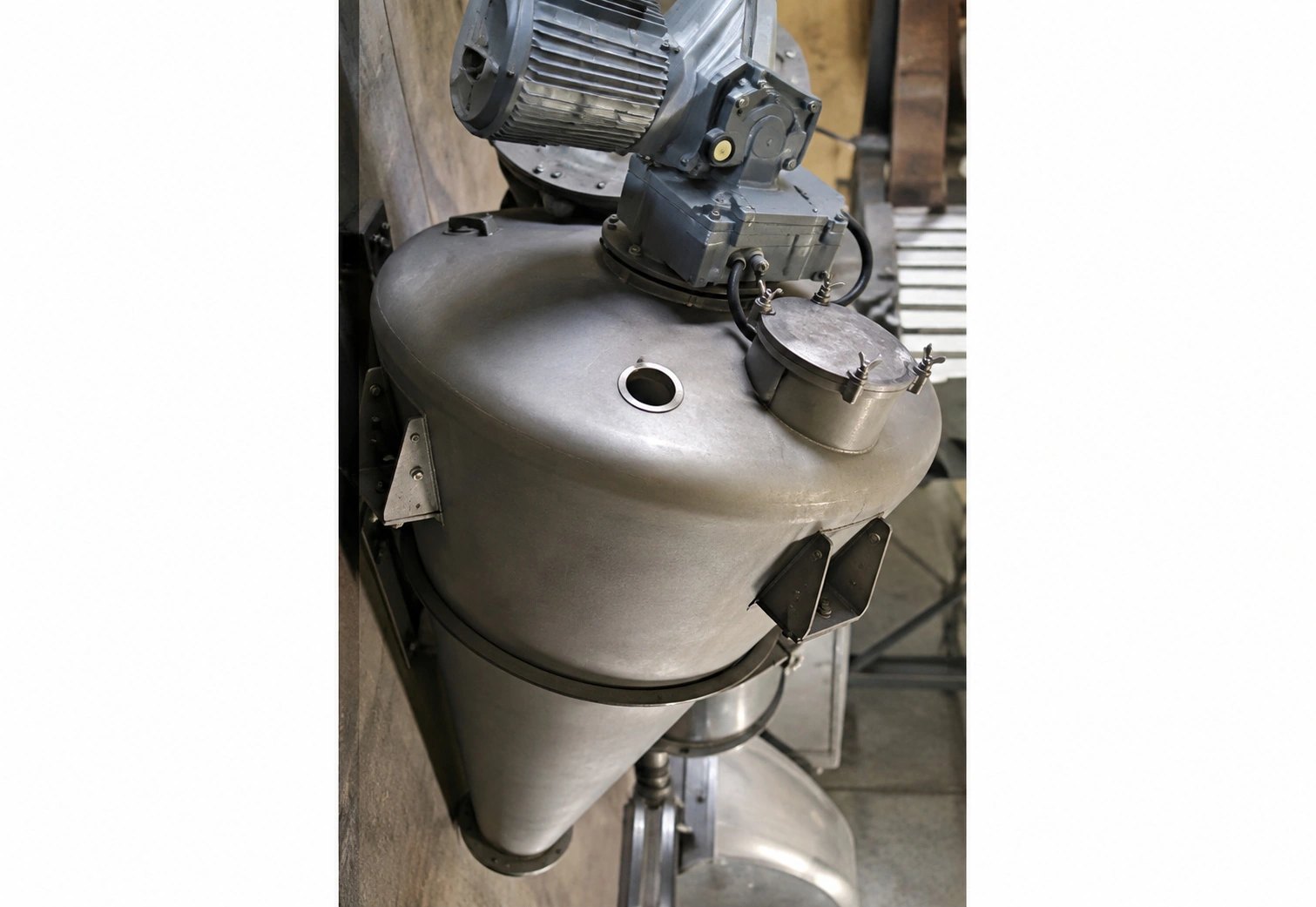
The drive produces simultaneous screw self-rotation and revolution around the vessel centerline.
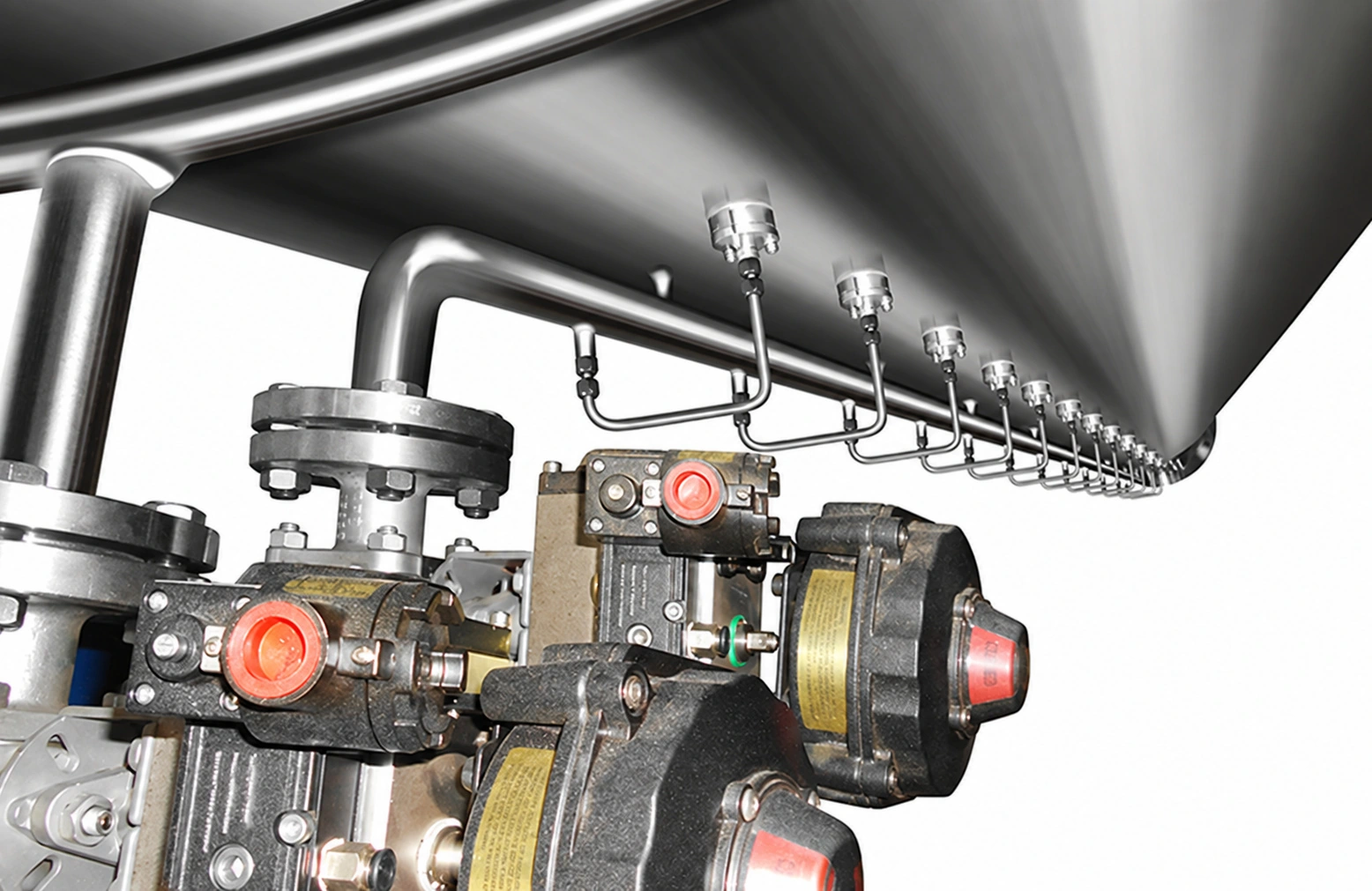
A central spray pipe and atomizing nozzles distribute small liquid additions. Compatible construction materials can be selected for acidic or alkaline liquids.
A suitable head design and increased vessel-wall thickness provide the required pressure resistance while maintaining cleanability.
Manual charging, vacuum conveying and mechanical conveyor feeding can be integrated according to the plant layout.
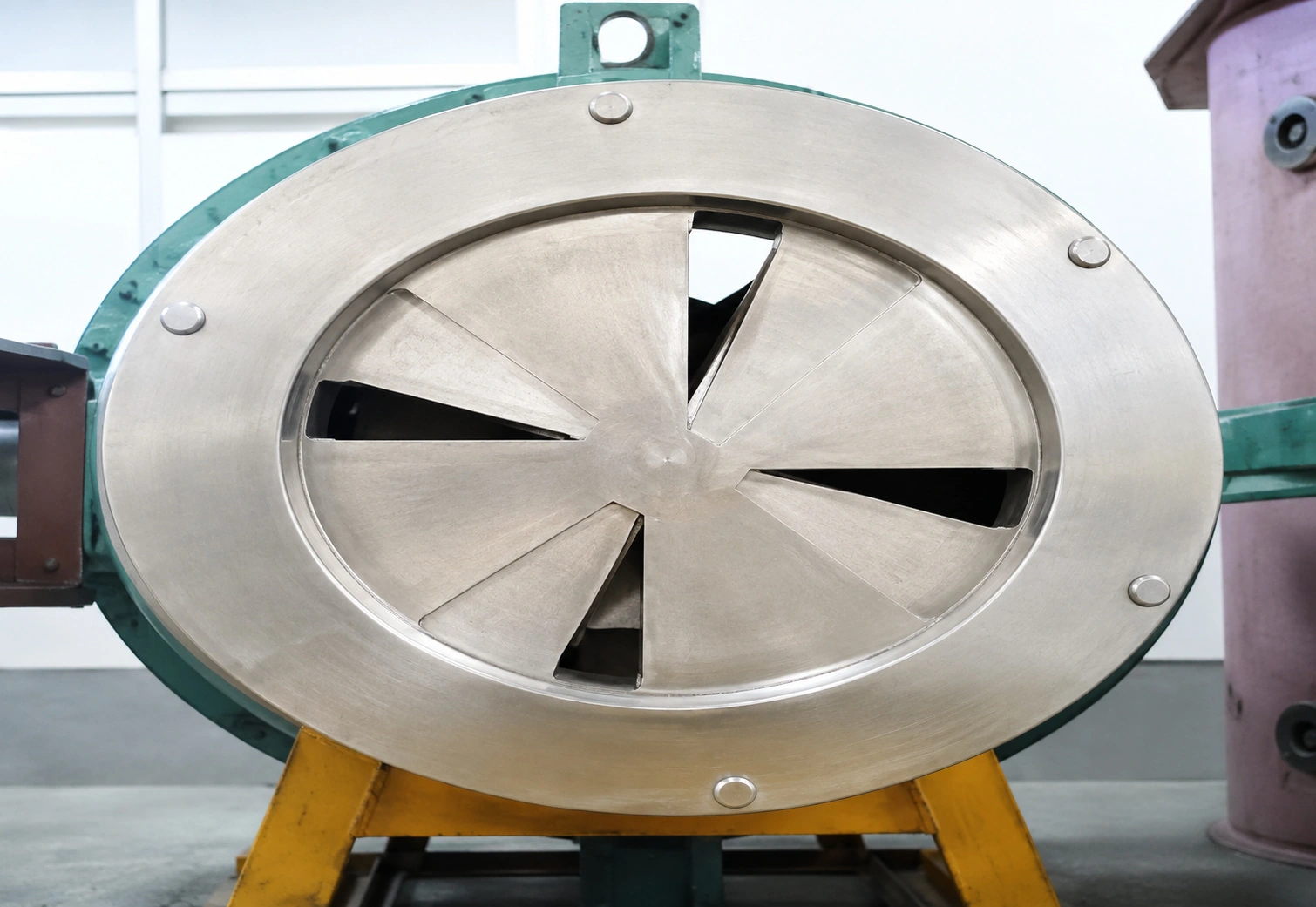
A lobed, offset valve fits closely around the bottom of the long screw to minimize unmixed pockets; manual and pneumatic drives are available.
Butterfly valves, ball valves, rotary airlocks and side-discharge arrangements can be supplied for downstream-process compatibility.
Internal spray cleaning can be specified, with cleaning media and drainage matched to the material and process.
A jacket can provide water cooling or steam/thermal-oil heating.
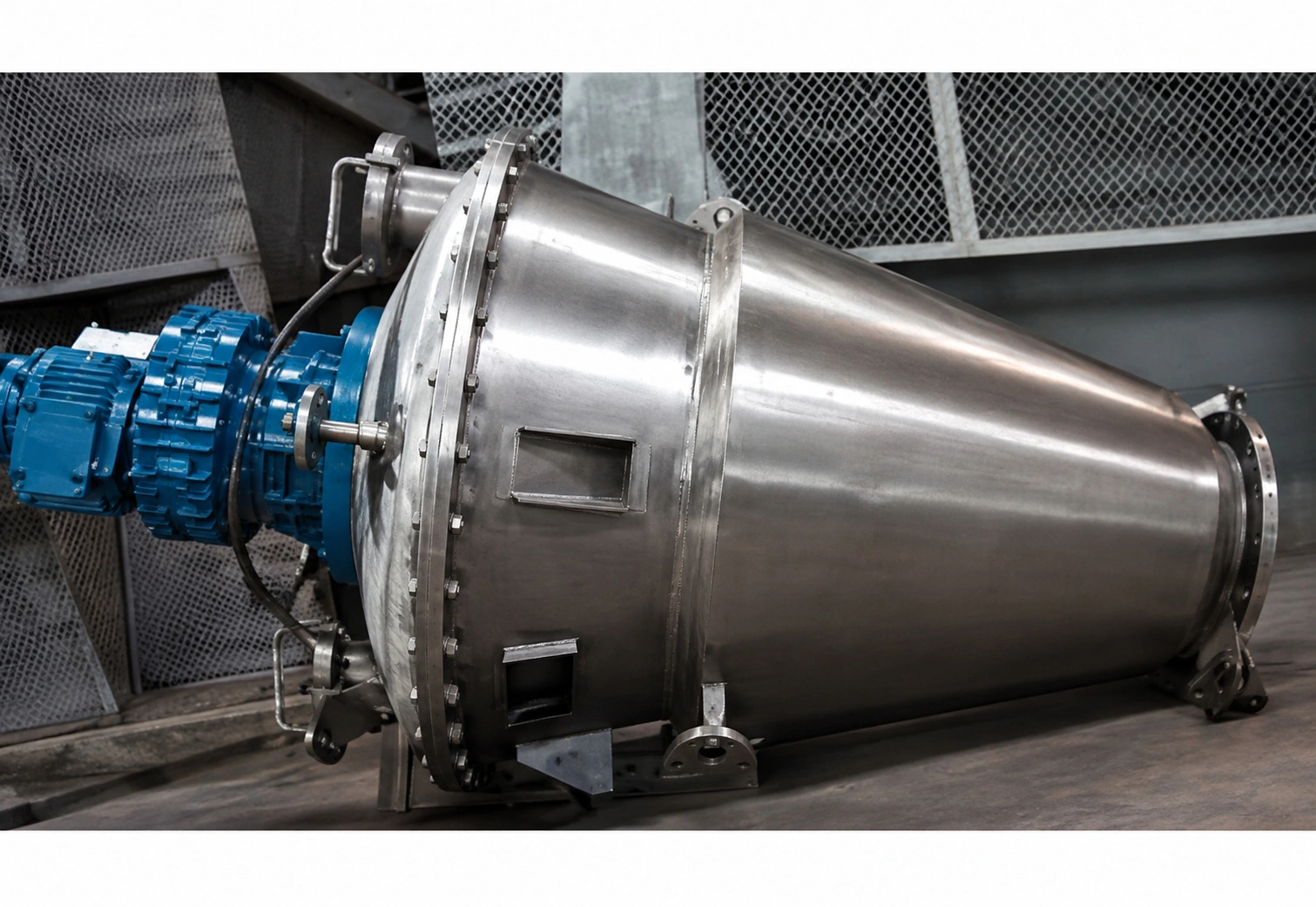
The top cover separates from the conical vessel to expose the screws and inner walls for cleaning and component maintenance.
Structure & Options
Images below illustrate the corresponding mechanical details and available configurations.
Selection Support
Share the following formulation, batch and process information for an efficient preliminary review.
Related Products